

… Elementary School received a grant to purchase touchscreen Chromebooks and technology resources to teach students computational thinking and …
from Google Alert – “Computational thinking” https://ift.tt/35GUJTX
via critical thinking
Author: erinconradmountainbradley hi
I am a IT teacher, who enjoys using and exploring technological tools -unconventional learning models opened up by 21st century technology. Avid reader and somewhat philosophical type (a Tektologist) in the Bogdanovian sense) out to explore the limits of where learning can go -from a comprehensive perspective.
Teach a girl to code and she’ll change the world
… and vocabulary drawn from the best-selling Girls Who Code books, clubs expose girls to bravery, resilience, and computational thinking at the exact …
from Google Alert – “Computational thinking” https://ift.tt/2R7qErb
via critical thinking
Engadget Podcast: CES 2020 and a chat with technologist John Maeda
… design choices companies like Samsung make, and discussed his new book, How to Speak Machine: Computational Thinking for the Rest of Us.
from Google Alert – “Computational thinking” https://ift.tt/306uqp2
via critical thinking
Pearson launches the UK’s first Computer Science GCSE to assess programming skills on-screen
Of the two externally-examined papers, one is a written exam covering computational thinking, data, computers, networks, and the issues and impact …
from Google Alert – “Computational thinking” https://ift.tt/36GDh33
via critical thinking
Adelphi University receives state grant for STEM labs
… math) disciplines has been gaining momentum in Garden City's educational circles, from the school district's computational thinking projects and the …
from Google Alert – “Computational thinking” https://ift.tt/2NewINx
via critical thinking
$2M in grants to develop computing-integrated teaching for K-12
Michigan State University scholars will help more teachers integrate computational thinking lessons into classrooms, thanks to more than $2 million in …
from Google Alert – “Computational thinking” https://ift.tt/2QX6ZdC
via critical thinking
Education innovations in Asia: 5 takeaways from Taiwan’s NXTEducator Summit
Education innovations in Asia: 5 takeaways from Taiwan’s NXTEducator Summit
By Lauren Ziegler
There’s no question that children in school today will encounter an entirely different workplace than the one we’re in now. The impact of new technologies and a changing climate will influence the kinds of jobs available and the skills needed to be successful in them. While it’s impossible to know what exactly the future will hold, education scholars are emphasizing the need for young people to acquire skills such as collaboration, critical thinking, and problem-solving. These so-called “21st century” skills will help young people thrive in an uncertain future. Around the world, innovators are finding new and creative ways to deliver such skills.
I recently took part in the NXTEducator Summit in Taipei on 21st century skills in Asia, which shed light on the many innovations in the Chinese-speaking world. Co-hosted by the Finnish nonprofit HundrED and the Sayling Wen Cultural and Educational Foundation in Taiwan, the summit brought together more than 100 teachers, administrators, and innovators across China, Taiwan, Singapore, and Malaysia to learn from seven featured innovators and exchange ideas for delivering a quality, future-ready education for all of today’s young people.
At the Center for Universal Education (CUE) at Brookings, we research education innovations, and the summit provided a window into current trends in the region as well as similarities we see across the globe that can help inform our future work. Below are five takeaways from the summit:
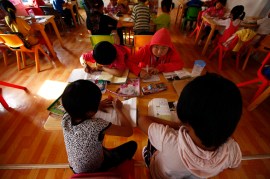
1. Leapfrogging is happening in the here and now. The summit’s featured innovators confirm that rapid, nonlinear progress in education, or what CUE calls “leapfrogging,” is alive and well in communities across the Chinese-speaking world. CUE’s leapfrog pathway highlights how innovation can move education from the status quo to a place where all young people develop the breadth of skills needed to be successful in the future. For example, the Co-Publishing Project in Taiwan works with economically disadvantaged students and students from immigrant families, putting them at the center of learning through hands-on photography projects. Student-centered learning is a core element of leapfrogging, as highlighted in CUE’s leapfrog pathway. The project fosters students’ curiosity about their own cultures and the world around them and allows for their self-expression through the art of photography. Another featured innovation, Teach for Taiwan, recruits university graduates and professionals to teach in economically disadvantaged primary schools through its two-year fellowship program, helping to address educational inequity among rural and urban communities. The innovation represents an example of widening the pool of teachers, another aspect of the leapfrog pathway.
2. Advanced technology is being harnessed for learning. While many well-resourced classrooms have tablets and computers, the use of drones in school is less common. The Drone-based Interdisciplinary Learning and Entrepreneurship Education program in Hong Kong has seized on the greater commercial availability of drones to further student learning. Secondary school students first learn about drones in the classroom, applying math, science, and coding skills to program drones and track their trajectories. They also meet entrepreneurs and professionals who use drones in their day to day careers. Students apply their learnings to the real-life measurement of water quality, first by engineering drones to collect water samples through a testing process in the classroom and then collecting samples from local bodies of water. Back in the classroom, students analyze the collected samples to identify levels of water pollution and pollution sources. The program enables students to solve a local problem through technology, while robustly building their 21st century skills.
3. Familiar models are being used in new ways. Innovation isn’t always the brand new, never-before-seen thing. Indeed, in “Leapfrogging Inequality,” Brookings scholar Rebecca Winthrop defines innovations in education as a break from current practice, whether new to the world or new to a context. Two featured innovations, BEEP Lab and FunMeiker, represent examples of an old idea being adopted to serve a new purpose. Both innovations use concepts from the field of architecture to teach K-12 students. The programs work with local architects as mentors who guide students through the processes of inquiry-thinking, design-thinking, and problem-solving. While architecture’s use in K-12 education is not brand new, these innovations are providing thoughtful, new ways to deliver context-specific concepts and ideas to children in Singapore and Taiwan, such as a focus on the natural and cultural environments in addition to the built environment.
4. Innovation is promoting empathy and cross-cultural exchange. Featured innovation MTA World (Mondragon Team Academy) is a university in which students spend each year in a different country. Students can choose to study in Asia in China and Korea, as well as in Spain, Mexico, and the United States. Instead of classrooms, learning takes place through innovation labs where students work in teams of entrepreneurs. MTA recognizes that when young people have the opportunity to interact with others from different backgrounds, they develop new perspectives and ways of working that will serve them throughout their lives. Another innovation that promotes cross-cultural learning at the tertiary level is City Wanderer, in which teams of university students take on challenges in their city that benefit underserved groups—for example by cooking meals for the homeless or spending time with elderly neighbors. By interacting with others from different backgrounds, students develop empathy and a commitment to improve their world.
5. There is tremendous opportunity for governments to help innovation scale. Six of the seven featured innovations are led by nongovernmental organizations (the seventh is a social enterprise). Many collaborate with formal education systems by partnering with schools to lead after-school and weekend programs. This trend mirrors CUE’s research. In its global catalog of nearly 3,000 education innovations, CUE found that two-thirds of innovations originated from the nonprofit sector, whereas only 12 percent of innovations originated from governments. While innovation tends to occur outside of formal systems for a number of reasons, there is great value in more fully bringing innovation into the mainstream, where it can reach millions more students. CUE has called for a mindset shift among leaders as a starting point to encourage greater uptake of education innovation by local and national governments.
While we can’t say for certain what the world of work will look like 10 or 15 years from now, the conversations at the NXTEducator Summit show us that the education innovations community is putting into practice a range of creative ideas inside and outside of the classroom.
from Education Technology https://ift.tt/39QREDX
via IFTTT
Education innovations in Asia: 5 takeaways from Taiwan’s NXTEducator Summit
By Lauren Ziegler
There’s no question that children in school today will encounter an entirely different workplace than the one we’re in now. The impact of new technologies and a changing climate will influence the kinds of jobs available and the skills needed to be successful in them. While it’s impossible to know what exactly the future will hold, education scholars are emphasizing the need for young people to acquire skills such as collaboration, critical thinking, and problem-solving. These so-called “21st century” skills will help young people thrive in an uncertain future. Around the world, innovators are finding new and creative ways to deliver such skills.
I recently took part in the NXTEducator Summit in Taipei on 21st century skills in Asia, which shed light on the many innovations in the Chinese-speaking world. Co-hosted by the Finnish nonprofit HundrED and the Sayling Wen Cultural and Educational Foundation in Taiwan, the summit brought together more than 100 teachers, administrators, and innovators across China, Taiwan, Singapore, and Malaysia to learn from seven featured innovators and exchange ideas for delivering a quality, future-ready education for all of today’s young people.
At the Center for Universal Education (CUE) at Brookings, we research education innovations, and the summit provided a window into current trends in the region as well as similarities we see across the globe that can help inform our future work. Below are five takeaways from the summit:
1. Leapfrogging is happening in the here and now. The summit’s featured innovators confirm that rapid, nonlinear progress in education, or what CUE calls “leapfrogging,” is alive and well in communities across the Chinese-speaking world. CUE’s leapfrog pathway highlights how innovation can move education from the status quo to a place where all young people develop the breadth of skills needed to be successful in the future. For example, the Co-Publishing Project in Taiwan works with economically disadvantaged students and students from immigrant families, putting them at the center of learning through hands-on photography projects. Student-centered learning is a core element of leapfrogging, as highlighted in CUE’s leapfrog pathway. The project fosters students’ curiosity about their own cultures and the world around them and allows for their self-expression through the art of photography. Another featured innovation, Teach for Taiwan, recruits university graduates and professionals to teach in economically disadvantaged primary schools through its two-year fellowship program, helping to address educational inequity among rural and urban communities. The innovation represents an example of widening the pool of teachers, another aspect of the leapfrog pathway.
2. Advanced technology is being harnessed for learning. While many well-resourced classrooms have tablets and computers, the use of drones in school is less common. The Drone-based Interdisciplinary Learning and Entrepreneurship Education program in Hong Kong has seized on the greater commercial availability of drones to further student learning. Secondary school students first learn about drones in the classroom, applying math, science, and coding skills to program drones and track their trajectories. They also meet entrepreneurs and professionals who use drones in their day to day careers. Students apply their learnings to the real-life measurement of water quality, first by engineering drones to collect water samples through a testing process in the classroom and then collecting samples from local bodies of water. Back in the classroom, students analyze the collected samples to identify levels of water pollution and pollution sources. The program enables students to solve a local problem through technology, while robustly building their 21st century skills.
3. Familiar models are being used in new ways. Innovation isn’t always the brand new, never-before-seen thing. Indeed, in “Leapfrogging Inequality,” Brookings scholar Rebecca Winthrop defines innovations in education as a break from current practice, whether new to the world or new to a context. Two featured innovations, BEEP Lab and FunMeiker, represent examples of an old idea being adopted to serve a new purpose. Both innovations use concepts from the field of architecture to teach K-12 students. The programs work with local architects as mentors who guide students through the processes of inquiry-thinking, design-thinking, and problem-solving. While architecture’s use in K-12 education is not brand new, these innovations are providing thoughtful, new ways to deliver context-specific concepts and ideas to children in Singapore and Taiwan, such as a focus on the natural and cultural environments in addition to the built environment.
4. Innovation is promoting empathy and cross-cultural exchange. Featured innovation MTA World (Mondragon Team Academy) is a university in which students spend each year in a different country. Students can choose to study in Asia in China and Korea, as well as in Spain, Mexico, and the United States. Instead of classrooms, learning takes place through innovation labs where students work in teams of entrepreneurs. MTA recognizes that when young people have the opportunity to interact with others from different backgrounds, they develop new perspectives and ways of working that will serve them throughout their lives. Another innovation that promotes cross-cultural learning at the tertiary level is City Wanderer, in which teams of university students take on challenges in their city that benefit underserved groups—for example by cooking meals for the homeless or spending time with elderly neighbors. By interacting with others from different backgrounds, students develop empathy and a commitment to improve their world.
5. There is tremendous opportunity for governments to help innovation scale. Six of the seven featured innovations are led by nongovernmental organizations (the seventh is a social enterprise). Many collaborate with formal education systems by partnering with schools to lead after-school and weekend programs. This trend mirrors CUE’s research. In its global catalog of nearly 3,000 education innovations, CUE found that two-thirds of innovations originated from the nonprofit sector, whereas only 12 percent of innovations originated from governments. While innovation tends to occur outside of formal systems for a number of reasons, there is great value in more fully bringing innovation into the mainstream, where it can reach millions more students. CUE has called for a mindset shift among leaders as a starting point to encourage greater uptake of education innovation by local and national governments.
While we can’t say for certain what the world of work will look like 10 or 15 years from now, the conversations at the NXTEducator Summit show us that the education innovations community is putting into practice a range of creative ideas inside and outside of the classroom.


from Brookings Topics – Global Education https://ift.tt/305ro4l
via IFTTT
Homework for students not teachers


It doesn’t really need to be pointed out that setting and marking homework is a drain on our time. As…
Let me explain how.
Firstly, in terms of being more effective, I refer to a comment from Amanda Spielman, HM chief inspector of education, children’s services and skills. In 2017, she said that “schools are focusing on preparing pupils for SATs and GCSEs at the expense of giving them a “rich and full knowledge”.
It appeared she was highlighting some schools’ tendency to teach to the test. With the pressure we’re under to raise standards, this isn’t really surprising. However, with the video pod resource we use, teaching those aspects of a story that are harder to grasp (often sub plots to the story – crucial but not the main concept) actually became a lot easier. By bringing the plots and sub plots to life visually, literature at Cardinal Wiseman is now made much more ‘real’. The students appreciate its meaning; they understand how the storylines evolve and relate to the world around us. This is a big part of making English Literature engaging to today’s students.
Put simply, using these videos helps the students to gain the “rich and full knowledge” that Amanda Spielman was calling for.
In terms of making homework easier for teachers to manage, I feel we’ve achieved this too. Once we have studied and discussed an aspect of the story or play we’re working on as a class, I set the student’s assignments and homework based on any gaps in their knowledge. The fact that I can do this so easily, with related videos as support and the relevant pre-loaded multiple-choice questions, is a real game-changer. The marking is done for me and I am automatically notified of any students who haven’t grasped the learning objective. This tells me how much knowledge each student has, and the areas where they need extra support in a much more meaningful way.
We see more research that suggests video technology is ideal for grabbing attention in many areas of learning but, for me, it’s ideal for English Literature. The mixed-media approach just resonates with young people incredibly well.
By following this teaching pathway, our students develop an in-depth understanding of the wider context of plays, their themes and the complexities of their characterisation and purpose.
Back in 2013, Cardinal Wiseman was rated inadequate, and one of the major issues identified was the consistency of our teaching. By ensuring that all teachers use curriculum-based and curriculum-aligned technology, we’ve been able to standardise the content, minimise planning time and ensure our students get consistent delivery of the highest quality of learning. We’re now rated as outstanding, and our approaches and the resources that we use play a major role in that achievement.
Matthew Everett, Senior Assistant Principal, at Cardinal Wiseman Catholic School, in Coventry, uses GCSEPod for its cross-curricula videos and supplementary learning content.

http://www.innovatemyschool.com/ideas/homework-for-students-not-teachers http://www.innovatemyschool.com/ideas/homework-for-students-not-teachers
Microsoft Translator in the classroom supporting collaborative learning


As a school, we are always ready to learn from and with others. Our creative and challenging curriculum, which we…
Over the last ten years, we have been lucky enough to take part in a whole range of international projects thanks to the platform eTwinning – supported in the UK by the British Council. We have designed board games for one another, shared favourite traditional stories, celebrated special events and even helped to reduce the amount of plastic waste within our different communities. These collaborations have helped the children fully appreciate the value of teamwork, collaboration and communication.
So this year, as a means of supporting our Finnish partner school with a project where our Y6 pupils were asked to help teach their children English grammar skills, we were delighted to be introduced to the fabulous Microsoft Translator app by the magnificent Donna Vaughan (@medv2). One of the barriers that we get with primary children collaborating with each other, is the issue of language and the children being unable to fully express their opinions to one another, which can obviously become frustrating and means that projects aren’t always able to delve as deep in to a subject area as much as people had initially hoped.
However, since we have started using the app, the children are able to fully express themselves due to the instantaneous translation that it provides. Through the free app, the two schools are given a safe and secure space to communicate with one another by sharing a unique code. For example, my class will type in their question or response to our Finnish partners in English, but then our partners receive the details in Finnish as well as English to ensure that they can fully understand what is being said. They will then respond in Finnish if they prefer and then my children will receive that response in the two languages as well. It really is that simple and incredibly accurate.

To say that the children have absolutely loved taking part in the project is an understatement. They have been so excited, teaching friends what adverbs are, how to use them and then giving quick-fire questions as a means of seeing whether or not their input has been useful. It has not only helped our colleagues in Finland to learn about the English language, but it has reinforced these grammatical terms for our own children as they have had to create special crib sheets with fully explained definitions, with example sentences as well as responses to expected questions in preparation for the sessions.
Alongside the teaching of grammar, the children have also been able to find out about the different hobbies and interests that the Finnish children have. Previously, when we have tried this, the response from our partner school has understandably been limited due to the language barriers. Children have been left saying what their favourite hobby is but not being able to fully explain why it is their favourite, due to their limited language skill. However, since we have started this project, we have found that we have been able to have much deeper discussions between the children. They are now able to find out so much more about each other and recognise many more similarities between one another due to the language limitations being removed. We have had the children discussing what they have done on holidays, how they have stayed safe online as well as comparing and contrasting the two schools. Rather than the teachers having to slow lessons down to translate what has been said or clarify what a child is trying to express, the conversations have been able to flow smoothly and coherently.
As the project progresses, we are not only hoping to continue to support one another with developing specific grammar skills, but also to discuss further aspects such as hopes and dreams for the future, as well as opinions on issues such as climate change and health and wellbeing. These are areas that we previously would have found difficult to fully explore, however, now that the children have the freedom of using their own language to fully express themselves, we think that the discussion will be much more insightful and challenging. Exactly what the children will want and exactly what they will need.

For more information about Shaw Wood Academy http://shawwoodacademy.co.uk
http://www.innovatemyschool.com/ideas/microsoft-translator-in-the-classroom-supporting-collaborative-learning http://www.innovatemyschool.com/ideas/microsoft-translator-in-the-classroom-supporting-collaborative-learning
 New innovative Approaches