What the coronavirus reveals about the digital divide between schools and communities

What the coronavirus reveals about the digital divide between schools and communities

By Nicol Turner-Lee

President Donald Trump declared a national emergency over the novel coronavirus, or COVID-19, which will provide $50 billion to the states working to accelerate virus screenings and deploy other emergency responses. But the funding may have come too late as concerns over COVID-19 have already injected chaos into American society, from concerns over the economy to empty grocery store shelves, inadequate access to testing, and clogged airports for those returning from abroad.

Yet another problem that deserves greater attention is the large number of students being asked to stay at home to further contain the spread of the virus. With a disproportionate number of school-age children lacking home broadband access, the breadth of the U.S. digital divide has been revealed as schools struggle to substitute in-school resources with online instruction, electronic libraries, streaming videos, and other online tutorials.

and every U.S. student could eventually be impacted by extended school closures. New York City, whose public-school system serves more than 1.1 million students, has announced the closure of its 1,800 schools. These mounting circumstances have administrators scrambling to migrate courses online and create some level of accountability between students and teachers. However, the U.S. digital divide makes any effort fallible for certain individuals, households, and communities that are not sufficiently connected.

Broadband availability has been at the heart of the digital divide with an estimated 21.3 million people lacking access in 2019, according to the Federal Communications Commission (FCC). Despite the narrowing of digital gaps between urban and rural communities, the latter still maintains lower than average connectivity rates with only two-thirds of rural Americans reporting a home broadband connection. Income is another factor restricting broadband adoption and use: because low-income families tend to be more smartphone-dependent, they lack access to multiple internet-enabled devices (e.g., tablets, PCs or laptops) to get online, according to a study by the Pew Research Center. School-age children are most affected by this lack of ubiquitous access with 35% of their households without broadband service in 2015. A few years ago, FCC Commissioner Jessica Rosenworcel referred to this phenomenon as the “homework gap,” where low-income students who lack online access lag behind their higher-income counterparts when completing assignments and other school-related activities.

San Francisco’s school district announced their school closure efforts with a desire to bring courses online, only to be faced with a reality check. The city sits alongside a few others with the highest rate of income inequality, according to a Brookings report. Further, a 2018 city-led assessment found that more than 100,000 San Francisco residents lacked home broadband access, especially low-income residents making less than $25,000 annually.

Established data caps on broadband services impose additional barriers on low-income subscribers who will be forced to ration minutes between the completion of their student’s assignments and online search queries for critical public services. Comcast was the first to respond to this quandary through its Internet Essentials (IE) program by suspending data caps for program subscribers for the next two months. The company also announced a series of other measures for IE customers, including increased download speeds, temporary reprieves on late fees, and making their Wi-Fi hotspots available to non-Comcast customers. Other internet service providers (ISPs) are engaged in similar responses to the coronavirus crisis.

But just like the U.S. government is working to contain the disease, we must tackle the broader shortcomings of not making digital access a national imperative. In his first term, President Trump announced plans to modernize the nation’s infrastructure, which would have included expanding internet access in underserved urban and rural areas. Instead, the consequences of the failed infrastructure effort are now exacerbated amidst a global health crisis. So, what can we do in the interim to reduce or avert an educational meltdown in the weeks or months before we get young people back to school?

park wireLess school buses in local communities lacking broadband access

Earlier this month, I published a report on the need to bridge the divide between schools and communities. One of my most glaring findings is the lack of local digital infrastructure that allows for the seamless export of digital learning experiences and tools into local communities and households. We are experiencing these inadequacies first-hand as a disproportionate number of school-age children lack access to both broadband service and the necessary devices. While libraries often fill the gaps in local access, the mandate of social distancing makes it virtually and physically impossible to use their services—at least in the short term. Further, many of these disconnected communities don’t have commercial establishments that offer free Wi-Fi, if one was daring enough to venture out.

However, in the U.S., there are approximately 480,000 school buses that transport about 25 million students on a  weekly basis to school and back. With newly installed Wi-Fi hotspots, these buses can maintain the integrity of current social distancing,

In 2016, the rural Coachella Valley Unified School District in California equipped its school buses with solar-powered Wi-Fi routers to provide internet while in transit and parked these outfitted buses in underserved neighborhoods to offer 24/7 online access. Coined the Wi-Fi on Wheels project, students have been able to access broadband where they live to reduce barriers to learning and obstacles to adoption. I’ve been told that Greenville County in South Carolina is parking their Wi-Fi equipped buses throughout their school district.

These efforts may not be a long-term solution, but they can address a current access gap.

bring device lending programs to school-operated nutrition centers

As schools make decisions to move curricula online, they are still restricted by the lack of access to devices at home for low-income students in urban and rural areas. But across the country, students eligible for free or reduced-price meals are being sent to onsite and mobile sites. In fiscal year 2018, the National School Lunch Program provided low-cost and free lunches to 29.7 million children in households with incomes at or below 130% in poverty. Schools and local libraries can partner to bring lending programs for hardware and other internet-enabled devices, including Wi-Fi hotspots, to needy students while they are at these centers.

Just as ISPs and other organizations are improvising through this crisis, other private sector partners, libraries, and philanthropic organizations can do the same and provide “one device per household” to address broadband deprivation among students. For households unable to obtain internet via a parked school bus, having temporary in-home access or even a list of locations for free hotspots can alleviate some of the disparities exacerbated by shifts to online learning.

we need to make closing the digital divide a global imperative

The U.S. is not alone in its effort to contain and stop the spread of the coronavirus. Globally, 105 countries have closed educational institutions from elementary schools to colleges and universities, affecting more than 897 million children and youth across the globe. The number of global school closures are increasing daily.

However, assuming most people are online would be the first mistake of policymakers as they work to mitigate our current health risks. The second mistake would be not thinking more globally about why everyone needs to be connected. Today, the problems of the digital divide are manifesting among students. In the future, it will challenge workers forced to move to telework. As we assess the broader impacts and implications of the coronavirus, one thing is clear—we are not effectively using and disseminating 21st century tools to alleviate current and unforeseen problems.

from Education Technology https://ift.tt/33o6OxO
via IFTTT

COVID-19 outbreak highlights critical gaps in school emergency preparedness

COVID-19 outbreak highlights critical gaps in school emergency preparedness

By Allison Anderson

The COVID-19 epidemic sweeping the globe has affected millions of students, whose school closures have more often than not caught them, their teachers, and families by surprise. For some, it means missing class altogether, while others are trialing online learning—often facing difficulties with online connections, as well as motivational and psychosocial well-being challenges. These problems point to a critical gap in school-based contingency planning within broader education sector preparedness planning and emergency management.

Contingency planning is a management tool to analyze the impact of potential crises and ensure appropriate arrangements are made to respond in a timely and effective way. The tool enables individuals, teams, and organizations to establish working relationships that can make a critical difference during a crisis. As such, education sector and school-based contingency planning for COVID-19 are essential to ensure that schools can manage future uncertainty by developing responses based on different outbreak scenarios, including variations in severity of illness, mode of transmission, and rates of infection in the community. The United Nations Inter-Agency Standing Committee has noted that an effective response at the onset of a crisis is heavily influenced by the level of preparedness and contingency planning.

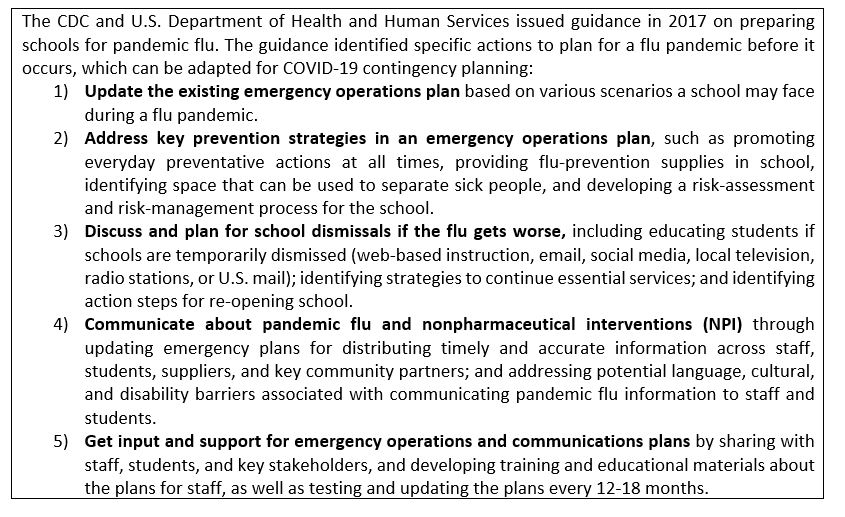
Education sector preparedness aims to protect students and educators, plan for continuity of education, and safeguard education sector investments, all of which ultimately contribute to strengthened resilience through education. The CDC and U.S. Department of Health and Human Services preparedness guidance for school-based pandemic flu notes that school-based outbreaks often give rise to community-wide outbreaks; thus, planning and practicing for such epidemics are an act of safeguarding not only the health of students and staff, but also of the wider community (see guidance below).

CDC and HHS guidance on preparing schools for the pandemic fluMuch of the global guidance for schools relating to the current COVID-19 epidemic focuses on keeping schools safe and students and teachers physically healthy through personal and environmental nonpharmaceutical interventions (NPIs). This includes communication about everyday preventative actions like encouraging students and staff to stay home when they are sick, covering coughs and sneezes, washing hands often, and disinfecting frequently touched surfaces and objects. Other schools in communities with isolated cases of the virus are instituting community NPIs, such as increasing space between people at school to at least three feet, making attendance and sick-leave policies more flexible, postponing or canceling large school events, and temporarily dismissing students.

The CDC guidance notes that in a severe pandemic, “dismissing schools preemptively before flu becomes widespread in schools and communities can help slow the spread of the disease in the community.” While many schools around the world have some sort of preparedness plan in place to deal with natural disasters, armed violence, flu and other emergencies, the vast majority have not planned for the prospect of monthlong or longer school closures, as is happening in China, Japan, and other countries to prevent COVID-19 from spreading. As a result, many schools, teachers, and families lack guidance about how to prepare for educational continuity and psychosocial support to students during long-term out-of-school closures.

Promising actions but critical gaps remain

UNICEF and Save the Children, two leaders in the education emergencies field, have health teams working with the World Health Organization (WHO) and other partners on multirisk preparedness activities across hundreds of country offices to ensure the safety of education programs, children, and affected communities. UNICEF is working with the International Federation of Red Cross and WHO to develop key messages and actions for COVID-19 prevention and control in schools that will serve as the basis for country-level guidance on risk mitigation and safety. This will include specific messages, actions, and checklists for school administrators, teachers, and staff; parents and community members; and students and children. The guidance will also contain a section on engaging students of different ages in health education to prevent and control the spread of COVID-19 and other viruses and to develop media literacy and critical thinking skills to combat social stigma and become active citizens. Save the Children is leading READY, a global consortium aimed at strengthening nongovernmental organizations to support affected governments for major disease outbreaks or pandemics, advocating that children’s best interests are at the center of every response. These actions by UNICEF and Save the Children to protect children and schools through preparedness are important, but neither tackle the preparedness aim of providing educational continuity during school closures.

This lack of research on and guidance for planning educational continuity is disastrous, as education is itself a form of psychosocial support that promotes holistic well-being during crises.

Yet the issue of how to provide quality educational continuity remotely that supports not only learning but also the psychosocial well-being of both students and educators is critical to effective preparedness and response. Countless countries over the past several decades—from Syria and Afghanistan to Somalia, the Philippines, Sri Lanka, and beyond—have trialed distance and flexible learning approaches to maintain a degree of educational continuity during times of crisis. Unfortunately, the learning from these trials has neither been systematically monitored nor evaluated to measure the impact of these different approaches. Moreover, it is not only the mechanism and approach that is used—from radio, podcast, or television broadcasts to online programs or virtual peer learning circles—but also the quality and methods of teaching that are critical to understand; this opens another set of important, but as of yet, largely unexamined questions about training and support for teachers in already strained educational environments. Until there is evidence on what alternative modes and methods work, and under what circumstances, it will be largely impossible for school districts and individual schools to develop comprehensive strategies needed for education contingency planning.

This lack of research on and guidance for planning educational continuity is disastrous, as education is itself a form of psychosocial support that promotes holistic well-being during crises. Intentional investment in education-based psychosocial support and social and emotional learning for children and youth affected by crises can help them learn more readily. Indeed, psychosocial well-being is a significant precursor to learning and has an important bearing on the future prospects of both individuals and societies.

This COVID-19 epidemic is surely not the last epidemic that will threaten school continuity, especially given research on how climate change will affect infectious disease occurrence. Schools must immediately update their emergency preparedness plans by developing contingency plans that not only address school-based prevention and safety measures for epidemics, but also identify ways to continue educating and supporting students and teachers if schools are closed. At the same time, the global education community must strengthen monitoring, evaluation, and documentation of alternative modes and methods of distance and flexible education work, including how they support the psychosocial well-being of learners and teachers. Ultimately, the global education community should synthesize existing research about distance and flexible education interventions in crisis contexts that can be contextualized at the school-level, so that the next time an epidemic strikes, schools are better prepared to not only protect students and educators, but to continue quality education.


from Education Technology https://ift.tt/3378lrY
via IFTTT

Cambodia’s strategic scaling of 21st century skills and assessment to improve learning outcomes

Cambodia’s strategic scaling of 21st century skills and assessment to improve learning outcomes

By Esther Care, Ung Chinna, Sarin Sar, Hav Khou

Cambodia has been striving to improve its education system and has engaged in as many opportunities as possible to further student achievement. The country has participated in OECD’s PISA for Development, in the UNICEF-sponsored South East Asia Primary Learning Metric (SEA-PLM) program, and in the Optimizing Assessment for All (OAA) initiative at Brookings. Drawing lessons from the very different approaches in these assessment programs, Cambodia has assembled an impressive repertoire of skills and knowledge.

Outstandingly, the country has not backed off from its mission to change the status quo in its education system. The Minister of Education, Youth and Sport, H.E. Dr. Hang Chuon Naron, has said, “I don’t care what the results are; I just want to know what they are so that we know what to do about it.” As a testament to this principle, Cambodia is just one of three PISA for Development countries that will continue engagement with OECD’s international large-scale assessment through PISA-2021, to provide comparative data across 2018-2021 that will reflect the impact of education initiatives currently being implemented.

Cambodia’s Education Quality Assurance Department (EQAD) of the Ministry of Education, Youth and Sport recently showcased its commitment to improvement in a two-day workshop. Concerned about the quality and usefulness of classroom-based assessment, the EQAD unit has developed a strategy.

The workshop

Held in the Kampot Provincial Teacher Training Center in February, EQAD assembled a diverse group of educators, with the conviction that educators from all levels of the system need to be brought into discussions on how to change practices. Following a series of sessions designed to familiarize provincial education officials and teachers with outcomes from OAA’s pilot assessments of 21st century skills, the EQAD staff worked with participants to develop assessment items for classroom use.

As the first short-term target, teachers designed items for use in monthly tests of student progress. An additional target for the monthly tests was to ensure at least one item per subject would reflect OAA’s approach of assessing 21st century skills embedded in subject curricula. Over time, this latter approach will be scaled up to support regular classroom teaching and learning.

An overarching goal of the workshop was to support teachers to move beyond the textbooks that they currently rely on to consider the curriculum more broadly. As Cambodia shifts away from reliance on rote learning, the teachers themselves need greater familiarity with the curriculum and curricular goals. The OAA assessment task structures provide exactly this facility: Not only do they require students to think beyond routine application of their learning, they model this approach to teachers.

Scaling 21st century skills

The app, Telegram, has allowed EQAD to provide just-in-time materials in their capacity-building activities. Educators can access Telegram easily on their mobile phones, download materials, chat, and send all sorts of documents and images, and thereby engage in a dynamic community characterized by quick interaction. As can be seen in the below images from the workshop, the phones provided an essential resource—unlike in many gatherings where individuals looking at their phones indicates disengagement. It was great to see the start of basic information and communications technology literacy in a Cambodian education context.

The Provincial Office of Education (PoE) staff and school directors, together with the Teacher Training Department and Primary Education Department, developed action plans to enable continuing technical item development for the school-based groups after the workshop. The plan is for the four pilot schools that participated in the OAA initiative to scale up to additional grade levels, with EQAD support, as their confidence and expertise builds. To support these activities, the schools will meet in their technical groups, one in Phnom Penh and one in Kandal Province, each month. The Telegram exchange of documents and sharing of resources will facilitate EQAD’s review of item drafts for use in the classroom as teacher expertise develops.

EQAD’s plans to share OAA procedures and practices with teacher training centers in other provinces and institutes so that both trainers and trainees can continue to build knowledge around concepts of 21st century skills assessment and incorporate it into teaching and learning. In the immediate future, EQAD will also scale up to two schools, Chaktomok Primary School in Phnom Penh and Takhmao Primary School in Kandal province. These schools will join the original four to work together to share knowledge and practices.

In many countries, we see responsibility for educational assessment separated across departments or centers, such that responsibility for large-scale testing is taken by one department, and responsibility for classroom-based assessment is taken by another. EQAD has acknowledged the importance of alignment between these different levels of assessment, and while responsible for Cambodia’s large-scale assessment, also values classroom assessment as the foundation for change in education practices. With EQAD’s work to create alignment throughout the system, as demonstrated by the workshop, the future of Cambodia’s education system looks bright.

from Education Technology https://ift.tt/2TEKdKh
via IFTTT

Webcast only: How should schools prepare for a coronavirus outbreak?

Webcast only: How should schools prepare for a coronavirus outbreak?

Since the arrival of the COVID-19 virus (also known as coronavirus) in the United States, there are now more than 250 reported cases and 14 deaths across 21 states. As the virus spreads, institutions across the country are taking measures to combat the epidemic. Given how easily illnesses spread in areas with high concentrations of people, schools have become a focal point in preventing the spread of COVID-19. As the virus spreads, some schools in the country have already closed, and many others are contemplating closures or remote learning. But many questions remain about when exactly to close schools, how to continue student learning in the interim, how to minimize disruption to parents, and a host of other considerations.

On March 11, the Brown Center on Education Policy at Brookings will host a webcast only event that will address how schools should prepare for and handle a COVID-19 outbreak. Panelists will discuss possible school closures and the medical, legal, educational, logistical, and equity issues that may arise with such drastic measures.

This event will be a live webcast only discussion. Viewers can submit questions for panelists by emailing  events@brookings.edu, or via Twitter at @BrookingsGov or using #COVID19Edu.

from Education Technology https://ift.tt/2PWREtY
via IFTTT

Bridging digital divides between schools and communities

Bridging digital divides between schools and communities

By Nicol Turner-Lee

Schools have historically been the beneficiaries of public and private sector investments in digital infrastructure, programs, and other resources. Funding has been primarily directed at in-school internet connectivity, after school programs and a wide range of related activities, including teacher professional development, e-books, and on-site computer labs. One of the largest sources of technology funding is the Federal Communications Commission’s (FCC) E-rate program, which invests in internet access and infrastructure in schools, including Wi-Fi. The 21st Century Community Learning Centers program, which was created in 1994 through a reauthorization of the Elementary and Secondary Education Act, also supports technology education for students during non-school hours. Combined, these federal programs have allocated nearly $86 billion in the last 23 years that can be added to numerous investments from philanthropic organizations and corporations.

However, getting internet to the school is just one piece of the puzzle in closing the digital divide and the growing “homework gap” in which students lack residential and community broadband access.1 Even in communities with exceptional broadband in their schools, how are student experiences affected when nearby institutions and establishments, including libraries, churches and other public facilities, have limited digital resources and connectivity? How does this impact students’ ability to share the digital experiences learned in school to the community?

The paper relies on data collected from visits to schools in two different cities—Marion, Alabama, and Phoenix, Arizona.2 Both schools were the beneficiaries of the ConnectED initiative (ConnectED), which was launched under the Obama administration to accelerate on-site internet access and teacher technology training in 2013. Public and private sector partnerships were at the center of ConnectED with participating entities providing financial support, equipment, wireless infrastructure upgrades, and software donations to eligible schools and libraries. Apple, Inc. was one of many corporate participants in the ConnectED initiative and provided the two schools profiled in this paper with tablets, software, and professional development workshops.

Given the availability of technology within each school, I explore how the in-school digital experiences of their students compared to access and use within the surrounding communities, especially among libraries, community-based organizations, and local businesses. More specifically, I examine both the availability and capacity of local entities to close the homework gap and the much broader digital divide in historically-disadvantaged communities.

While this paper provides detail on how each school implemented their partnership with the Apple and ConnectED initiative, my primary focus is on the school and community connections, especially as students’ technology use is often contained within educational institutions. I conclude the paper with a series of proposals and programs to bridge these local divides that are stifling robust digital interactions in low-income communities.

The White House ConnectED initiative

In the 1990s, lively debates on the digital divide ensued, largely focused on strategies to enhance public computing access, equipment, and software and digital literacy training for providers and users. Former deputy administrator of the National Telecommunications and Information Administration, Larry Irving, coined the term “digital divide” to compare the experiences of those who were online with those who were not.3 These citizens were disproportionately people of color, foreign-born residents, high school dropouts, older Americans, and rural residents.

A steady stream of federal, state, and municipal support would soon follow, going to community technology centers (CTCs) to address these digital access disparities. Government resources, including those allocated from programs like the former Broadband Technology Opportunities Program (BTOP) administered by the U.S. Department of Commerce, primarily supported the expansion of CTCs, which were often created and operated by community and faith-based leaders. Private philanthropy later supplemented BTOP by providing additional grants to CTCs and other community-based organizations focused on closing the digital divide.

Generally, the programmatic efforts happening in schools and communities were established to address the persistent divide, which still affects more than 10% of U.S. citizens who either do not have access to high-speed broadband or have no general interest in technology.4

Parallel to the conversations on community technology were ones related to expanding digital access in schools, resulting in a plethora of resources. This included smart boards and other in-classroom devices, online messaging tools, and interactive web-based tools for educators, parents, and students. Professional development for teachers was also a priority as more schools adopted new technologies with the goals of introducing new pedagogical frameworks for classroom instruction.

“New industries, including those empowered by artificial intelligence and machine learning algorithms, are quickly transitioning citizens from an analog to a digital economy.”

Today, innovation is steadily increasing as evident in new online products, services, and platforms. New industries, including those empowered by artificial intelligence and machine learning algorithms, are quickly transitioning citizens from an analog to a digital economy. However, American students fall behind their peers from China, South Korea, and Singapore when it comes to creating and working in this new gig economy. While some research argues that the global disparities are due to the lack of access to universal, high-speed broadband networks in the U.S., the availability of devices, teacher readiness, and earmarked resources to expand digital proficiencies can also be blamed.5 Further, the homework gap—a term coined by FCC Commissioner Jessica Rosenworcel—is rapidly widening as schools and communities fail to develop digital bridges into the places where students live.6

In June 2013, the Obama administration created the ConnectED initiative after learning that teachers in certain communities were often experiencing subpar internet access compared to other American households.7 The program goals were to fix disparate online access for students in public schools, with a specific focus on unreliable and slow internet that was preventing teachers from effectively using technology in the classrooms.

When first announced, ConnectED’s explicit goals included:

  • Connecting more than 99% of students to the internet in their schools and libraries at speeds of no less than 100 megabits per second (Mbps) per 1,000 students at a targeted speed of 1 gigabit per second (Gbps) by 2018.
  • Creating partnerships with the private sector and nonprofit organizations to make affordable devices available to students.
  • Training teachers to incorporate technology into the classroom.

One year after its announcement in 2014, the private sector quickly reacted and joined the administration’s effort, including Apple, Microsoft, Verizon, AT&T, and the Sprint Corporation. Since the program’s start, Apple has awarded $100 million in in-kind donations, including hardware, software and necessary Wi-Fi and other infrastructure upgrades. Participating schools, including the ones surveyed in the paper, have received iPads, software, and teacher training as part of Apple’s competitive, national grant program.

Research methodology

As part of my research, I chose to focus on two awardees of the Apple and ConnectED program, largely due to the presumption of existing technology resources within the school. The first case study is on Francis Marion School, a pre-K through 12th grade consolidated school in Marion, Alabama, and a program grantee since 2016. The student body of Francis Marion School is 98% African American, and predominantly low-income. The school is in the Perry County School District, a highly rural community that is approximately two-hours from the city of Birmingham. Perry County has a long history of fighting racial segregation. In 1966, the school district was part of a landmark state desegregation case after the noticeable concentration of Black students in public schools.8 The history, along with its location, made the inclusion of Francis Marion unique, along with the size of the student population (700 students). Francis Marion students were also able to take their devices home because of available broadband service on their iPads (a program to be discussed later in the paper).

Pendergast Elementary in Phoenix, Arizona, is the second case study for this research and another grantee since 2016. Pendergast received iPads for all students and benefited from three years of professional development training from Apple. Unlike Francis Marion, Pendergast students were not permitted to take their iPads off campus.

Located in Arizona’s Maricopa County, the student body of Pendergast Elementary is 95% Latino, and majority low-income. The school is in the western outskirts of downtown Phoenix with a large population of undocumented immigrants. Maricopa County has an embattled history of villainizing immigrants under the leadership of former Sheriff Joseph Arpaio, who was notorious for racially profiling and detaining Latinos in the Phoenix area.9 After 24 years in office, he was unseated and sentenced to prison for his unfair and unconstitutional treatment of Latino residents, many of which were not legal residents at the time.

In addition to their demographic differences, I also chose each school because their respective local communities have a vast range of local assets, including libraries, local businesses, and nonprofits. This information was ascertained prior to actual field visits through an online search.10

For each case study, data was compiled through direct interviews with principals, teachers, parents, and community leaders. Students were not interviewed for this paper, but observational data may be shared.11 Prior to the start of the site visits, research permissions were sought and approved by district superintendents.

The next section provides case studies of each school, relying upon the qualitative data collected during the interviews and field visits. Following this section, common themes and recommendations for improving community digital access are shared, including active legislative proposals.

Francis Marion Elementary School


Overview

Alabama ranks 47th or below on reading and math scores for the 2019 National Assessment of Educational Progress.12 In Alabama, 59% of students are white, 33% are African American, and the remaining percentages are other racial and ethnic groups.13 Of all students in Alabama public schools, 52% are economically disadvantaged. The state’s Department of Education shows reading, math, and science proficiencies generally fall slightly below 50% for all categories. The graduation rate for the state is roughly 90%, with about 75% of students ready for college, according to state standards.

“Of all students in Alabama public schools, 52% are economically disadvantaged.”

Francis Marion School, one of two schools in the Perry County School District, is a consolidated pre-K through 12th grade school with 694 students, 99% of whom are African American.14 More than 70% of the students are economically disadvantaged. The students’ performance in core studies, including reading, math and science, fall at 23%, 19%, and 15% respectively, ranking near the bottom of Alabama schools on standardized test scores. Despite these low scores, 92% of students graduate with a little over 50% ready for college.

In Perry County, broadband access is at an all-time low, with only 39.8% of households being connected to the internet, according to U.S. Census Bureau data from 2013-2017. Alabama ranks 41st in the nation in terms of broadband connectivity and download speeds.15

The school’s principal is Dr. Cathy Trimble. She was born and raised in Marion, Alabama, and has been in the district for almost 30 years. Before becoming principal, she only left the city for college and soon returned after her now-husband became the school’s physical education teacher. Dr. Trimble started as a substitute teacher in the Perry County school system, and over the last three decades worked her way into the role of the school’s top administrator.

At the time of the proposal submission to Apple, the school was only serving high school students. Soon after the grant was awarded, the school went on the state’s failing list and risked closure. The district immediately drafted the plan for the school’s consolidation, which now enrolls students from pre-K to high school. The resources were successfully redirected to the consolidated school, which makes their case study unique because of the school’s size.

In 2016, Francis Marion School received 700 iPads as part of the program; the inventory is still the same in 2019. All students receive an Apple iPad as part of their classroom experience and can take them home at the end of the school day. Dr. Trimble fought through racial stereotypes in her decision to permit home use. “Because we are African American, people thought that [the students] were going to sell or lose their iPads,” she shared. “But, in one year, we may have lost two or three and one of them, someone [in the community] called and told me [the location of one of these iPads].”

As mentioned, internet access is not readily available in Marion, Alabama. On my drive into the community from Birmingham, the two-lane road was flooded with colorful signs marketing cheap internet offers. Dr. Trimble considered the lack of home broadband access as a primary reason for her decision to allow home use, recognizing the potential of the device to have a multiplier effect in the students’ household. The equipment at Francis Marion is also bundled with AT&T broadband service so that the students and other family members can also access the internet at home.

“Before the program, I would come to the school on the weekends and see parents pulled up in their vehicles using the school’s Wi-Fi,” Dr. Trimble stated. “When we first got the iPads without the broadband package, kids would still be sitting on the ground or on the stoop, doing their homework or studying,” she continued. With some ingenuity, she brokered the deal with AT&T, ensuring that her students had access to Wi-Fi during the school year.

Creating digital norms in schools

Some researchers have argued that having effective leadership in schools is the first step in the slow acculturation to and adoption of technology.16 The leadership drives the vision for school technology use to energize participation by amplifying the critical importance of digital resources. Integrating technology into the existing culture of the school was challenging, according to Dr. Trimble. At the program’s onset, she had to encourage teachers, students, and parents to use the technology, and develop new teaching methods, which was very uncomfortable for many of her teachers. Thoughtful in her choice of words during the interview, Dr. Trimble detailed how she walked each group through the transition, starting with the basics on how to turn on the tablet.

In their research, Tyler-Wood, Cockerham, and Johnson (2018) share the difficulties that new technology presents in rural schools: less-equipped teachers and other disparate physical resources make technology integration more difficult in rural schools, layered on top of insufficient funding.17 Francis Marion is no exception. Parents were brought into the program at the start to not only gain buy-in, but also to identify their own needs. Parallel with the program’s implementation, the school instituted a parent computer lab where adults could fill out job applications or conduct other online business. Students were also empowered to manage the lab and work with teachers to secure the school’s computer equipment against viruses. Dr. Trimble called these “baby steps” to help stakeholders gain “the basics of the basics” after realizing their low levels of digital proficiencies.

Staff development is also a critical element of the school’s success, according to Dr. Trimble. Further, an organizational realignment to accommodate the technology helped her to create and shift roles among some faculty to ensure positive outcomes. A science teacher at the school, Gylendora Davis, was given the joint role as a tech and media instructor. In my interview with Ms. Davis, she supported the principal’s technology integration plan:

Students already know some of this stuff because they have cell phones. Dr. Trimble has just made it mandatory to bring technology into our lesson plans. There are some challenges with us, teachers. We had to figure out a way to put a lesson into our regular curricula and use some of the available online content on the iPads.

Francis Marion is empowering their teachers to look beyond the traditional subjects associated with technology, including math and science to the arts, music, and writing areas that are usually less technical. “Our students are coding, learning robotics, and also engaging the arts,” Dr. Trimble shared. “Sometimes, it’s not uncommon for the students to even lead the teachers on ideas of what to cover.” Her students are also using more advanced technology applications, such as designing QR codes for research projects and using iMovie for storytelling.

Going fully digital in classroom instruction is an aspiration of the Francis Marion School. “What we have now is a prelude to what is to come,” Dr. Trimble predicted. “I see us progressing to a mobile music program where the band director can help students learn how to play instruments from mobile devices. Marching bands are popular here in Alabama that would be such a complement to what the kids can do now.” Unlike schools that struggle to maintain technology as a core part of science and mathematics, Dr. Trimble’s extension into the humanities and arts may be able to foster increased adoption by both students and teachers.

“In this rural town of Marion, the optimism around the technology in the school is going viral among students, teachers, and parents.”

In this rural town of Marion, the optimism around the technology in the school is going viral among students, teachers, and parents. In my observation of students exiting the building at the end of the day, most of them had an iPad under one arm and a mobile phone in the other hand, suggesting that the school’s culture is embracing digital use. One of the fifth-grade teachers supported what I saw by saying: “[The school] starts early to give these students the right values around the use of technology. Most of the students have phones, but we want to show them what the world will be like with forthcoming virtual and augmented realities. We are not stopping.”

Research suggests that African Americans access the internet via their mobile devices at a much higher percentage compared to white individuals.18 Moreover, these populations tend to be “smartphone dependent,” relying only upon their mobile device as a gateway to the internet. While such access can be promising, some of the challenges with the homework gap refer to students’ inability to use their phones to complete research papers or other assignments that require more robust internet and device access. Fluctuations in monthly costs can also lead to more service interruptions for this population, resulting in less consistent access for lower-income households.19

The ability to complement smartphone access with a tablet may serve to lessen the barriers to broadband adoption at home and in the school. A 2008 study from the Board of Governors of the Federal Reserve System reiterated this point by concluding that teenagers who have access to home computers are 6–8 percentage points more likely to graduate from high school than teenagers who do not have home computers.20

Dr. Trimble shared her plans for sustaining the momentum of her students’ technology use for the next few years, given the formal partnership with Apple ended in the summer of 2019:

Next school year [2019-2020] will be the first time without Apple and their program. The students will still have their tablets and we have now built the technology into lesson plans. Going forward, we have teachers who are ready to further customize the curricula to the different grade levels. When we gave the tablet to the high school students, they saw it as a new way to get on social media, but now, we are pushing it toward college applications. Last year, 100% of our graduates went to college. So, we have to keep going.

Given the school’s commitment to contributing to the learned digital experiences of its students, what role does the surrounding community play in reinforcing these goals? In what way can technology access in schools become a catalyst for expanding local access?

Making tech the new normal in Marion

It’s no question that technology access within the Francis Marion School has been a game changer, forcing a new level of digital engagement and responsibility among students and faculty. However, these digital accomplishments are not necessarily changing the broader community.

“We are doing such a good job [at the school] that many of these students are deciding not to return home,” Dr. Trimble shared. What she is referring to is the increasing exodus of families from Marion in search of new opportunities, especially given the downward turn in the local economy. “This town used to be thriving,” Dr. Trimble stated. “The plant for Mercedes Benz [in nearby Tuscaloosa] used to be a reliable source for jobs before it closed. Now, some students are traveling within the South and even above the Mason-Dixon Line to attend college. In some cases, students are leaving school early to go with their parents who are finding work outside of the city.”

During the interview, one of the parents, Twanda White, stopped by the office to let the principal know that she accepted a job in Selma, Alabama. Twanda was moving immediately with her children just one month into the school year. “I’m going to miss this school and Dr. Trimble,” she said. “My son was not doing well last year, then he got an iPad and he was able to get his grades up because he got more interested in school. I remember telling myself, the principal has taken my child from me because he always wants to be at school.”

When asked about her own technology literacy, she continued, “I already know some things, but the program here has helped me to do things like apply for jobs, send my references, and track my application.” Unfortunately, it is the lack of access to livable-wage jobs in the city that make it impossible for single parents like White to survive in Marion.

While one might think that the existence of technology would be transformative by itself, a mismatch exists between these added resources, the broader impact on educational achievement, and insufficient local opportunities—particularly jobs.

For example, Francis Marion is on Alabama’s failing school list, despite having access to such robust digital resources and cultivating increased student engagement. “I almost feel inadequate,” Dr. Trimble stated. “We have successfully changed the culture of the school, but our test scores don’t reflect this.” States like Alabama still rely upon traditional learning metrics and assessments to rank city schools, particularly test scores. Alabama also publishes a state report card on a school’s progress in terms of student attainment. Francis Marion is on that list.

Race may be a factor in this distinction from other schools. Jim Crow laws established a legacy of historically segregated schools in the South, which could explain the high ratio of African American students at Francis Marion. While explicit educational discrimination was outlawed in Alabama, segregation is now driven by income and wealth inequalities, causing communities like Marion to have more concentrated populations of lower-income students.21 The school is also nearly 100% African American because many affluent white families in the community send their children to the local private school.

While the technology program appears to have increased student engagement, research also concludes that it is not a catalyst for improved test scores, or at least not immediately.22 Digital access alone cannot dismiss the structural and social discriminations affecting communities of color. But, the case of Francis Marion suggests that it can improve upon school culture and drive some level of student engagement by empowering teachers to be more creative in classroom instruction and equip students with new tools. As suggested in conversations with Dr. Trimble, having access to technology breaks the mundanities of living within Marion where opportunities are limited.

From my observations, Dr. Trimble is committed to improving upon the life experience of her students and stands firm in her conviction to the school:

I feed these children when they are hungry. I cry with them and their families when they are going through something. I used to complain about them to the teachers. But, somehow, God just won’t release me from here.

For communities and students to be full beneficiaries of digital technology, it also seems natural to share these online experiences within their respective communities, thereby building local capacities and creating shifts in acceptable digital norms and practices.

However, three months out of the school year, or on summer break, Francis Marion students are without their iPads. “The kids in this community do not have a lot of places to go, and I know that they wait for the iPads to return,” she said.

The divide between the community and school

Marion, Alabama, resembles other rural towns. The usual temperament of the town enveloped by farms and green pastures is quiet. Sounds do make it into the more bustling commercial district where local businesses sit across from City Hall and the local library. A few blocks from Main Street is a tall water tower inscribed with the town’s name, which marks the town’s boundaries.

The library in Marion has computers and patrons have full access when it’s open. On the day of my visit, the library—which is about two to three miles from the school—was closed. Dr. Trimble shared that the library is a main resource for the students, if they can get there. Common transportation barriers or an unavailable parent or guardian stymie continuous traffic to the local institution.

Across from the public library is The Social, a newly opened ice cream parlor. The building blends into the row of antique stores and sits next to a Southern-cuisine restaurant. As described by Dr. Trimble, The Social is just that—a place for ice cream, board games, and internet access. It is new to the community and when I walk in, the large space is lined with rectangular tables from the entrance to a few feet before the ice cream parlor. A high-top table surrounds the walls of the space with appropriately-sized chairs for use. Board games are scattered on tables and a sign invites patrons to use the Wi-Fi.

The owner is an African American woman, Betty Cadore, who sold her house in Bridgeport, Connecticut to relocate to Marion one year ago. “My daughter was working here as a Teach for America fellow. I came to visit her and loved the community so much that I moved,” she shared. “Local people didn’t think that we would last,” she continued. “But we are still here.” Aside from her daughter, who now works at Francis Marion, the Cadores have no family connections to the town except through the family business.

In addition to ice cream, Cadore also provides breakfast to local kids on their way to school. One of her daughters commented, “My mom is here at 6:30 am every morning. She saw a need for breakfast and wanted to provide that for the young people.”

While schools are abundant with resources primarily earmarked and targeted to educational gains, surrounding communities lack the digital infrastructure to support the technology training that happens within schools. Getting to any of these places may also require some form of transportation.

“We sometimes have more white people here [at The Social] than [Black] students because they have no transportation,” Cadore pointed out. “I really wish that I could figure that problem out because we are here to offer a safe space for the kids to do their homework.” From this statement and the general case study findings, it was also clear that there were not too many places that offered Wi-Fi or fixed broadband services to community residents.

Francis Marion’s experiences closely resemble the findings at the second school, Pendergast Elementary School in Phoenix, Arizona.

Pendergast Elementary School


Overview

The district that houses Pendergast Elementary School has 13 schools that enroll pre-K to eighth grade students. The district has 9,753 students and 500 full-time equivalent teachers, creating a student-to-teacher ratio of 19.5. In 2018, per student spending in the district was $7,438, compared to $8,269 statewide. In 2017, average spending per student in Arizona was the fourth-lowest in the nation.

The students at Pendergast Elementary are predominantly Latino, many of them the children of undocumented workers. Of the 813 students at the school, 85% are of Hispanic origin. In state math assessments, 29% of students in grades 3-8 scored “proficient” or “highly proficient.” In science, only 39% of students “meet” or “exceed” state requirements.

The school building overlooks the mountains, complementing its open architecture and LEED compliance. Pendergast is a green school with eco-friendly student work stations scattered around campus. Technology access is prevalent at the school. Students have access to a 3D printer and in-classroom smart boards.

When walking into the school, the faculty were welcoming. The receptionist behind the first entry way has a nameplate on her desk that reads: “Like a boss.” Students in school uniforms appear to embrace her title as evidenced by the number of them approaching her for help. There is a constant exchange of “excuse me” and “thank you” as I wait for the principal. Arizona state law bans the use of bilingual education, so everything is taught in the English language.

Getting the school connected

Principal Mike Woolsey is an almost “lifer” like Dr. Trimble. For decades, he has been the principal at Pendergast and a resident of Phoenix. Like his counterpart from the rural South, he wants to leverage the technology to ensure that his students have exposure to 21st-century tools and jobs. He applied for Apple’s competitive grant program with the goal of expanding the horizons of students. “I wanted our kids to have options [so] that they are not stuck, unless they want to be,” he asserted. “Many of their parents didn’t finish school. I want my students to thrive instead of survive in this world,” he continued.

When Principal Woolsey wrote his grant to the Apple and ConnectED initiative, he started with the assumption that most of the students had smartphones. His teachers were already depending on these devices to assist with homework. “We don’t send a lot of homework home,” Principal Woolsey shared. “But what I have done is to enable applications on smartphones since most students have them.”

Like African Americans, Latinos also have a heavy reliance on smartphones. Approximately 25% of Latino populations are “smartphone dependent” and use their mobile device as their only gateway to the internet.23 In addition to accessing basic services, this population uses their devices for email, entertainment, government services, health care, and other relevant functions. But like Francis Marion, students with only smartphone connectivity may be challenged in completing research papers or other extensive assignments.

The school received the award from Apple in 2016. Since then, the iPad program has provided a cushion between students’ smartphone use and their lack of home PC access to generate more interest and engagement in the digital economy. Mobile access is important in this community of immigrants—many of whom are undocumented. Principal Woolsey shared how the egregious acts against immigrants have affected his students:

First, some of my parents are afraid to drive their kids to school. They drive with their passports in hand because of the fear. Maricopa County had a bad reputation because our neighborhoods were targeted by coyote people 10 years ago and had to pay ransoms.

He continued: “Most of the students and their families have mobile phones for safety. Our parents are afraid to leave the house. Here, a phone is about safety and staying in contact with that child.”

Like Francis Marion, Pendergast undertook several steps to design and implement its one-to-one technology solution, starting with a formal plan. “You have to plan for the technology with an implementation plan that you can revise,” continued Principal Woolsey. “And, you shouldn’t put in place a plan of tech to just substitute paper.”

At Pendergast, students in certain classes can take home their devices, including those enrolled in STEM classes. Unfortunately, not all students have broadband access at home. Cox Cable has a low-cost broadband offering, but the school is unsure of how many households subscribe. For Principal Woolsey, the main implementation of technology happens on campus.

On the point of local broadband access, Ruth Roman, the library media technician, commented, “Most parents do not have internet at home. Every year, we have a hard time getting the parents to complete the required paperwork for free or reduced-price lunch as a result.” Referencing Cox’s low-cost program, Roman shared that subscribers that she knows are usually signed up on a “pay as you go” basis.

Being an Apple and ConnectED recipient has helped the school to reach some of their technology goals. Both Roman and Principal Woolsey agree that the school quickly benefited from the program’s equipment and software donations, as well as the structured teacher training. Reflecting on his school’s experience in setting up the program, Principal Woolsey stated: “We were able to upgrade our network. There was so much to do, but each time we got better at it.”

Like Francis Marion, stolen devices among the student body are not an impediment at Pendergast. “We have had these iPads for three years and had zero theft,” he shared. “There will always be fears versus benefits. In my opinion, the benefits outweigh the fears.”

Teachers at Pendergast underwent a paradigm shift related to the use of technology in the classroom. The principal had to first get buy-in and then work to phase in aspects of the new applications, software, and hardware. Beginning with the expansion of the role of library instructor and technician, the school quickly put in place policies and infrastructure, including a mobile iPad cart that could be transported to each classroom.

Eliza Oldham, the technology teacher for kindergarten through eighth grade, led the efforts to connect parents to the program and address their fears about technology. She shared during her interview that the program has helped young people in the home teach their parents about these online tools, making it more comfortable for the parents. In her research, Katz (2010) found that while media experiences have primarily benefited more affluent communities, they can generate more trust within immigrant communities when young people serve as brokers to online information.24 In a survey of parents and children in an immigrant community in Los Angeles, her findings demonstrated that children’s use of traditional and newer forms of media helped in the settlement of their families.25

“At Pendergast, technology access has also encouraged students to explore STEM careers.”

At Pendergast, technology access has also encouraged students to explore STEM careers. “[At the school], we tell the students about jobs in coding and help them with resumes to get them started on their job search,” said Ms. Oldham. Additionally, the technology program at Pendergast Elementary School is also used to provoke problem-solving among students, an action favorable to teachers.

Mr. Quinones, a fifth-grade teacher, used his iPads for a research project where the students had to identify and write about women of color in the community. While his students couldn’t take their devices home, they used the time in school to engage in cultural and ethnic studies research. Once the project was completed, they shared their presentations with the subjects of their research.

The class project was a success for students and community leaders, despite some parents not attending. In response to this, Mr. Quinones shared: “We need a program for adults so they can see what we do at school. We want them to be able to help their kids.”

Tech exposure and test scores are not aligned

Having robust exposure to digital resources does not lead to improved test scores at Pendergast, nor is it proven anywhere else at this time. While interviews with the principal and teachers suggest a more collaborative approach to learning can be beneficial, their students still lag others in state test scores.

Like Dr. Trimble in Marion, Principal Woolsey experiences the same type of disbelief around how local schools are assessed under rigid state standards—despite huge investments in new digital resources. “Our states still seem to see these things as black and white,” he commented. “We are teaching our kids how to thrive and not survive in the new economy, yet when it comes to testing, they can’t compete with other schools and other districts. For some of my students, this is their first experience in a formal school setting.”

Pendergast’s large immigrant population largely contributes to the school’s rank, but this phenomenon is not unfamiliar among schools in low-income areas whose achievement gaps are already well documented. Moreover, educational research suggests very little correlation between technology access and test scores. In 2019, a report by the Reboot Foundation found that test scores decreased for fourth graders who used tablets in “all or most” of their classes.26 However, some variance appeared among students when the technology was used for research, problem-solving, or complimented some other critical thinking skill.27 While more research needs to be done on whether technology can be a catalyst for improved test scores, both principals identified an increase in student engagement, which could be an interesting correlate itself.

A 2019 Gallup study on student creativity found that teachers who leveraged technology to assign “creative, project-based activities” experienced more positive responses from students, including higher self-confidence, and improved critical thinking and problem-solving skills.28 While the merits of such performance could be argued, these findings suggest an increased level of student engagement as demonstrated at both schools at the core of this paper. As Principal Woolsey described, “We want to push our kids to do more extended things that go way beyond their personal experiences.”

This part of Phoenix is a digital desert

However, limited resources available in the surrounding community can impact the students’ digital learning. “We need more involvement from the community,” Principal Woolsey stated. “Kids have TVs at homes. They need access that will help them improve their lives. Every app that we use at school should be able to go home.”

The surrounding community is without many local resources for students when it comes to online access. Only 79.6% of the households in Pendergast’s school district have broadband subscriptions, despite the city of Phoenix being among the most connected cities in Arizona.29

More than a half-dozen pawn shops, liquor stores and used-tire establishments line the main streets around the school. Given the school’s location, a car or sufficient public transportation is needed to get around. The school assistant, or “the boss” shared, “Students’ households lack adequate transportation and because of the climate, they do not walk. It’s too hot. And when they have internet access at home, most of the students go on[line] for entertainment.”

There are two local libraries near the school—each approximately five miles from the school on opposite sides. I visited one—Desert Sage Library, which took me approximately 15 minutes to get to by car. Like schools, libraries have also been recipients of grants to bring more access to communities. In this library, more than 20 computers were lined between the books and the walls. People were actively logged in and the location was extra quiet as patrons maintained their focus on their screens. In front of two librarians was an African American woman who was trying to renew a library card but was told that she had to go online.

Her name was Francis and she had just moved to Phoenix to escape the cold weather in the northeast. She was recently separated from her spouse and patiently waited for her son to finish playing a game on one of the library stations. When asked how she would ultimately obtain her card, she shared that going online would be her best bet, but she’d have to wait to use her son’s phone. She gave it to him for emergencies at school.

“You can’t do nothing without being online,” Francis said. “Social services prefer that you go online and now the library. If you want to apply for a job, go online. Everything is digital and a lot of older people don’t even know how to do it.”

In many ways, Francis speaks to the challenges that the Pendergast teachers shared. There is a huge digital divide within local communities that restrict the full use of new technologies. In the case of adults, they have to learn as they go, or as Francis put it, “I need to rely on my son to help me get things that I need online.”

Francis also shared the challenges of doing everything over a mobile phone. “If you do it, like internet surfing, on your phone, it’s a cost [in terms of data] and I’m not working right now, so this all adds up.” She is aware of the low-cost broadband program available through Cox, but for someone on a limited income, that is still more than she can afford. Her son is in high school, so he cannot participate in the iPad program. Instead, he has a Chromebook provided by the school district to which she directed some reservations: She’s not sure if he’s using it for homework or gaming.

However, Francis understands the importance of being connected. Recently, she visited her doctor and was given an advanced stage cancer diagnosis. Because the doctor was able to reach her on her son’s phone, she was admitted to treatment immediately. “My doctor put all of my records online, through something like My Chart,” she recalled with half of a smile. “And, here I am today getting treatment.”

The need to support the intergenerational use of technology is obvious from my interview with Francis. Deploying technology between the schools and communities can potentially create a multiplier effect that not only amplifies in-school investment, but also builds the individual and community capacities necessary to thrive in an increasingly digital economy.

Bridging local divides between schools and communities

In a lofty illustration, the two case studies suggest that the inside of the schools appear to have a few gallons of water, while the community—though rich in family and institutional connections—is dehydrated or thirsty. As a result, some residents are compelled to relocate despite the positive effect the school’s technology program is having on their children. Or, residents may be digitally stuck because the robust and contained use of technology within the school does align with absent local opportunities. Overall, these communities are experiencing their own local divides, where the resources within schools are not often imparted into the surrounding communities, and vice versa.

Generally, what I discovered during both site visits is that Pendergast and Francis Marion have shared goals when it comes to the effective integration and adoption of technology by students, faculty, and some parents. Yet, they are sucked into educational models that restrict technology use to the facility, and as a result, are forced to measure student growth through traditional metrics.

Principal Woolsey described this challenge as feeding into the acts of survival that his families undertake from being fully disconnected. In Marion, students are similarly trapped within stalled local economies that fall behind the opportunities emboldened in the new information economy. In both case studies, school-based technology programs alone face obstacles to changing the economic and social trajectories of students. First, the current methodology for deploying digital access is school-centered. Second, the surrounding communities are digitally barren and unable to reinforce these digital experiences, or at best, keep these students connected.

Thus, creating a local digital infrastructure starts with mapping the available assets within a community, from libraries, community-based organizations, and local champions like Betty Cadore from The Social. In their research, Rideout and Katz (2016) pointed to the benefits in creating such local supports, primarily because they advance intergenerational cooperation and adoption of new technologies. Thus, there is a logical need for more engagement by local institutions, including libraries, community centers, and other gathering places, for families without home access to get online.30 Francis Marion is an exception when it comes to home-use of school devices. But not all schools can provide an in-home resource or have technology available at all, leading to increased inequalities that will only widen as the information economy becomes more widespread.

“Local libraries are not only the most visited when it comes to public computing, but they are the most utilized asset by individuals without home internet access.”

Local libraries are not only the most visited when it comes to public computing, but they are the most utilized asset by individuals without home internet access.31 In most rural communities, the library is normally the anchor of local activities, such as government services, benefits enrollment, and tax preparation services. Yet, some local libraries are still far from where some local people live, work, or go to school, thereby compromising their ability to do more. Librarians and other staff are also tasked with a variety of functions from checking out materials to helping individuals apply for jobs and access government services. Challenged by limited funding, staff, professional development opportunities, equipment, and software, local libraries can themselves become barriers to adoption.

Community-based organizations, including CTCs, and local businesses are also other local resources that permit free Wi-Fi use, like The Social and, in some cities, the local McDonald’s. However, these institutions also have limited times for availability, may require additional collateral (e.g., a library card or enrollment), or are restricted by limited bandwidth to available unlicensed Wi-Fi.

In the end, schools need connections to reliable, convenient, and safe local digital infrastructure, inclusive of libraries, community-based organizations, and even households to bolster their activities. This can address the growing divides that are quickly widening within low-income and rural communities.

The final part of the paper offers recommendations that make home and community internet access more readily available and supports intergenerational efforts to establish local digital norms around technology among certain groups. The next section also surfaces legislative proposals to advance community-based technology access that overcome the barriers associated with the homework gap.

How to enhance connections between schools and communities


1. Make community internet access available 24/7 to low-income students and their communities.

Several U.S. cities have deployed lending programs for Wi-Fi hotspots, in addition to providing computer centers. The New York Public Library launched in 2014 a lending program in response to a survey revealing that 55% of library patrons did not have internet access at home. For families making under $25,000, the percentage increased to 65%. Initially seeded through a $500,000 Knight News Challenge Grant, the pilot focused on public school students who lacked home broadband access and through additional donations targeted 10,000 households with internet access.

The Chicago Public Library has also deployed a similar initiative in three libraries that allow residents to check out a Wi-Fi hotspot like they would a book. By mid-2016, the library had 973 wireless internet hotspots for checkout through their Internet to Go program.

In addition, creative solutions to bring internet access to where students are is demonstrated in the wiring of local school buses. In 2013, the rural Coachella Valley Unified School District (Coachella Unified) in California was the first to provide iPads to every K-12 student as part of their mobile learning initiative. Because 95% of students live below poverty, they are challenged in their transportation to local institutions or do not have the economic means to subscribe to a monthly broadband service. In 2016, the school district equipped its school buses with solar-powered Wi-Fi routers to provide internet access while in transit. When stationary, the buses were parked within underserved neighborhoods to offer 24/7 Wi-Fi coverage.

Coachella Unified’s Wi-Fi on Wheels project has enabled broadband internet where students live to minimize the obstacles that disrupt use between the school and community. The program has resulted in a jump in district graduation rates from 70% to 80%, according to one study.32

In 2017, Google piloted a similar initiative, Rolling Study Halls, in the Berkeley County School District that enables broadband on 28 school buses. The program has since been expanded to 16 additional school districts and provides Wi-Fi routers, data plans, and devices for students to use while in transit.

Policymakers are finally understanding the need to empower local resources. In May 2018, Sens. Tom Udall (D-N.M.) and Cory Gardner (R-Colo.) introduced a bipartisan bill to equip school buses with internet access. The bill extends the FCC’s E-rate program—which provides schools and libraries with affordable broadband services—to reimburse school districts for the cost of outfitting their buses with internet access. In a press release on the bill, Udall stated, “It’s time to end the homework gap. Our legislation will help give all students the ability to get online to study and do homework assignments while they’re on the bus—a common sense, 21st-century solution.”

In 2019, Rep. Grace Meng (D-N.Y.) introduced a similar bill to reduce the homework gap. Meng’s bill, the Closing the Homework Gap through Mobile Hot Spots Act, would develop a $100 million grant program for libraries, schools, U.S. territories, and federally recognized American Indian tribes for the purchase of mobile hotspots. According to Meng’s press release, the mobile hotspots program would be established for students in need of internet access for homework completion. In her statement, she reinforces the need for such action:

Every child deserves their best chance at pursuing an education. But it breaks my heart knowing that millions of kids, every night, are unable to finish their homework simply because they are without internet access. Before the internet became ubiquitous, students completed their homework with pen and paper-today, that is no longer the case.

Taken together, these two bills can help scale and sustain many of the pilot programs being instituted within local communities while closing the homework gap. Although most of these programs rely upon philanthropic and private sector support, the adoption of federal legislation would bring more certainty in terms of appropriations and deployment, making these programs less vulnerable to political changes like the ConnectED program.

2. Create more intergenerational projects between schools and local communities to foster broadband adoption and use.

Between 2008 and 2011, the Mooresville Graded School District in North Carolina issued 4,400 Apple MacBooks to students in grades 4–12. Subsequent gains were seen in graduation rates from 80% to 91%, and students exhibited greater proficiency in reading, math, and science—73% to 88% overall. But their story, as some suggested, had less to do with the availability of hardware and more to do with the leadership and their plan for technology deployment. According to its website, the district continues to distribute laptops to its students. It has been the online content, teacher development, parent engagement, and student outcomes that make their technology program effective.

The same type of methodical deployment was adopted by both principals in my case studies. With the help of the Apple and ConnectED initiative, these leaders also revamped existing processes and staff roles to ensure a seamless integration of the technology into the classroom.

What’s even more comparable to the Mooresville lessons is the time spent by both schools on creating the trust of technology among students, teachers, parents, and other community members. In communities of color, intergenerational connections are fundamental to this process, especially as the parents and caregivers of students experience a host of other social problems. For example, when Dr. Trimble decided to allow her students to bring home their iPads, she was appealing to the intergenerational relationships within her community while enabling additional online activities for family members, such job searching, distance learning, among other functions.

Research has long supported the role of students in influencing parents to engage new technologies.33 When young people become “brokers” to new technologies for their parents and other caregivers, there is a higher likelihood of broadband adoption within the home and a greater exploration of the functionality of the internet (e.g., for health care, employment, and other critical decisions). Children are often seen as the most trustworthy source for families when it comes to internet use. In her research, Corea (2012) found that despite one’s demographic status (as defined by socio-economic status, income, family structure, among other variables), young people are the key agent for introducing and integrating technology into the home.34 Thus, the imperative to create more robust, local programs that enhance intergenerational engagement could be one of the bridges between schools and local communities. The fifth-grade research project at Pendergast was an attempt to pull the community into the school, which is an incremental step in creating a more digitally enabled community.

“When young people become “brokers” to new technologies for their parents and other caregivers, there is a higher likelihood of broadband adoption within the home and a greater exploration of the functionality of the internet.”

Other nationally known programs are attempting to build such bridges. For the last nine years, Comcast’s Internet Essentials program has been offering low-cost broadband to low-income families, using young people as digital connectors or local ambassadors for training and service within their respective communities. In some affiliate programs, students receive community-service credit or a small stipend for their efforts.

Establishing both trust and purpose for the technology is important for schools, community-based organizations, and other local institutions introducing digital resources.

3. Consider technology as a catalyst for increased student engagement in schools and communities.

Despite the availability of digital resources, schools like Francis Marion and Pendergast are assessed by stringent metrics, including student grades, test scores, and college enrollment. Low-income schools start with a deficit and consequently must catch up with more affluent institutions. While the an in-school technology program and available local resources should be ingredients for more effective learning, such goals are often unrealistic given the basis of cognitive retention around test scores and the institutional funding and staffing constraints for certain communities.

While the Apple and ConnectED initiative offered a framework for how designing and implementing a robust technology initiative, both principals faltered at changing overall student achievement. Going forward, more research is needed to understand how technology can be used to foster improved test scores, or if the reliance on test scores are representative of student performance at all.

What is apparent in both case studies is that both principals awakened some of the dormant realities of their students, who were simultaneously navigating through distressed economic and social circumstances. On this point, a Francis Marion high school student shared, “I really didn’t know what I could do for myself until we received an iPad.”

While test scores may not be affected, student engagement within schools can improve. In the 1960s, this type of educational quagmire was understood in the failures of Brown v. Board of Education to create parity within public schools. Facilities were still separate and unequal, despite the legal mandate of desegregation. As a result, low-income and rural poor schools faced the academic repercussions of these inequalities as demonstrated in poor student achievement and growth.

In many ways, schools like Francis Marion and Pendergast are still experiencing the historical effects of being on the wrong side of segregation. Yet, technology access has the potential to enliven the energy of dissatisfied and disassociated teachers, as well as students whose socio-economic status often dictates predictable (or discouraging) life outcomes.

Moving toward an ethos that assesses how technology affects student, parent, and teacher engagement should count for something. The increased inquiry and activity happening within America’s low-income and remote rural schools can be considered progress, especially if more students are enrolling in college or, at least, enhancing their critical thinking and problem-solving skills. Further, measuring increases in student engagement as a corollary to boredom or disengagement should be added to the conversation on school performance. In both case studies, each principal was excited about the potential of technology to change the course of their students’ life trajectories.

Policymakers, state education officials, and educators should start to explore more fully such indices to measure how schools are adapting to the skills necessary for 21st century advancement. Further, educational districts should be calling upon their affiliated schools to explore these opportunities to ensure that parents and other caregivers are provided with the same type of interest and proficiency in new digital skills. As summarized in an old cliché, “it takes a village.”

Conclusion

Getting closer to parity with the time and investments made around technology in schools and communities is one of the primary arguments of this paper. There are benefits to having more robust bridges between where students learn and live in places that ultimately influence their future decisions. The schools in this research have clearly surfaced why technology access is critical for their students as it slowly develops the norms and values for future participation in the new economy. Each case study also demonstrates the importance of making relevant community connections to better prepare households for the burgeoning digital economy so that the tide of progress rises for all and not just the fortunate few.

Nicol Turner Lee is a Fellow at the Brookings Institution, and the author of the forthcoming Brookings Press book, “Digitally Invisible: How the internet is creating the new underclass.”


Special thanks to everyone at Pendergast Elementary and the Francis Marion School, as well as Brookings’s Jack Karsten and Lia Newman for their help with this report.


The Brookings Institution is a nonprofit organization devoted to independent research and policy solutions. Its mission is to conduct high-quality, independent research and, based on that research, to provide innovative, practical recommendations for policymakers and the public. The conclusions and recommendations of any Brookings publication are solely those of its author(s), and do not reflect the views of the Institution, its management, or its other scholars.

Apple, AT&T, Comcast, Google, Microsoft, and Verizon provide general, unrestricted support to the Institution. The findings, interpretations, and conclusions in this report are not influenced by any donation. Brookings recognizes that the value it provides is in its absolute commitment to quality, independence, and impact. Activities supported by its donors reflect this commitment.

from Education Technology https://ift.tt/3akABK6
via IFTTT

How has the coronavirus impacted the classroom? On the frontlines with Dr. Jin Chi of Beijing Normal University

How has the coronavirus impacted the classroom? On the frontlines with Dr. Jin Chi of Beijing Normal University

By Rebecca Winthrop

The spread of a new strain of coronavirus (COVID-19) has been on the forefront of everyone’s minds since its appearance in Wuhan, China in December 2019. In the weeks following, individuals worldwide have watched anxiously as the number of those affected has steadily increased by the day, with more than 70,000 infections and more than 2,000 dead. Despite nearly hourly media coverage of this public health crisis, one area hasn’t received as much attention as it should: the outbreak’s impact on education. 

In China, schools have closed indefinitely, putting the education of the country’s youth into question for the immediate future. Despite the evident difficulties in resuming studies given the government-mandated quarantine, technology and online learning have taken on new importance for student learning. National response has been rapid: A national online learning platform launched, with the goal of reaching the over 180 million primary and secondary-aged students suddenly unable to attend school. Additionally, more than 20 online curriculum platforms and 24,000 courses for higher education institutions became available within weeks of the initial cases.

I recently spoke with Jin Chi, 2018 Echidna Global Scholar and professor at Beijing Normal University specializing in education and child development, about how the virus has impacted her research and education in China as a whole. As of today, it has been four weeks since Jin has left her apartment.

Q: The coronavirus has disrupted education across much of the country. Can you describe the situation around you?

A huge challenge is that COVID-19 is highly contagious, so teachers cannot meet with students, and parents are caring for kids at home. In Shanghai, Zhejiang, and Guangdong, it is estimated that classrooms will be formally closed for the next few weeks, and all private after-school tutoring has been banned. Libraries, universities, schools, and education companies in China have begun using digital resources, and most can be accessed for free during this unique time. But the popular use of these information communication technologies (ICTs) and the available open digital resources do not necessarily make learning happen.

Q: Currently, the country is fully engaged with battling the coronavirus.  Can you tell us how that has impacted you and your work to date?

So far, I have stayed in my apartment in Beijing for four weeks. To get our food, either my husband or I go out and buy enough for two weeks for my family and my parents’ family, and drop the food at their door. We understand that staying at home is critical not only for our own sake, but for those around us, as well as the medical workers jeopardizing their lives in this battle against COVID-19.

My regular work has been affected, as I have an ongoing international comparative research project in Wuhan, which I was last able to visit in November. The project involves collecting data in rural and urban schools onsite, and one of the research sites is nearby where early cases of the virus were identified. Luckily, the research team members and participants working on my team are safe. As most team members live in the cities near Wuhan, they haven’t left their homes at all for more than a month. In the hopes of resuming research, I’m going to apply for an extension of my contract, though I can’t be sure about the timeline for the next stage.

I’ve been relying on ICTs for many purposes. Aside from getting messages about COVID-19 from my WeChat friend circles and official accounts, I use my cell phone to provide my on-time location for health reports to my university every morning and work in several WeChat working groups with my colleagues. At present, I’m busy exploring how to provide professional support for teachers to enhance ICT competency for quality teaching and learning to handle these kinds of risks in education.

Q: Can you tell us more about schools in China trying to restore education through online learning?

Recently, there’s been a boom of online education in the country, with big online education platforms becoming crowded with users. The ministry of education in China has promoted “stop classes without stopping learning.” Schools, universities, and local education departments are providing education resources and learning support for students, though online learning is considered a temporary alternative. Some teachers are growing stressed dealing with the challenges of online teaching, including the lack of face-to-face interaction and sometimes unreliable technology.

Q: It has just been a few weeks so far with online learning. Can you tell us what is working well and what are the main challenges?

Given that teachers and students cannot meet in person, the advantage of online learning is clear. Teachers have formed groups to learn best practices from each other, consult with technical staff, and master different kinds of online teaching platforms. In the future, there is a need to better prepare teachers with ICT competency in advance, to ensure online teaching and learning can continue in another emergency.

To help bolster teachers’ ICT competency, I’ve been working with my colleagues at the Center for Teacher Education Research at my university to provide a one-stop online teaching and learning support platform. It will provide teachers with the technical information for ICT tools and platforms, general guideline for online teaching, practical education resources, and other support, including feedback for teachers’ questions and psychological support.

During this short period of time, the challenges have been twofold. First, online platforms should include multiple options for meeting practical teaching needs, such as synchronized video and voice for group learning and classroom interactions. However, in poorer or more rural areas, this has been limited by the technological facilities or even the cost of electricity.

Second, we need to rethink how education can be effective for students’ overall cognitive and noncognitive development (the educational goal in China) with e-learning. There are challenges in teachers interacting with students through online education, as only a few teachers take students’ feelings and interests into account.

from Education Technology https://ift.tt/32xKlhe
via IFTTT

How to design a university: A conversation with Doug Becker of Cintana Education

How to design a university: A conversation with Doug Becker of Cintana Education

By Rebecca Winthrop

About 220 million students are in higher education around the world today, but there are tremendous challenges in scaling those numbers. Nine out of 10 students globally do not have access to ranked universities, which tend to be the ones with the greatest resources in teaching and research. One solution is pairing unranked universities with ranked universities to lift up the quality of higher education for students across the globe.

In an ongoing exploration of trends in higher education, I recently sat down with Doug Becker, the founder and former CEO of Laureate Education, a company dedicated to expanding access to higher education around the world. Today, Doug has embarked on a new venture dedicated to advancing the science of university design and giving more students around the globe access to a high-quality education. Given the increased demand for higher education coupled with the rising costs and questions about the relevance of the skills required in a fast-changing world, there is considerable need to examine the design of higher education institutions globally.

Q: You have deep experience in higher education globally. What are some of the biggest challenges you see with higher education outside the United States?

A: In many of the countries that should be seeing the greatest amount of growth—for example, because of a growing middle class and workforce demand for higher education—the supply of qualified employees isn’t sufficient to meet the needs. Supply might be constrained by people’s ability to pay, by rapid change in workforce demand, or the absence of faculty with the prerequisite skills. So, it is really a question of what we should be doing to strengthen the universities which serve the vast majority of students but are not top-tier, ranked institutions with substantial resources necessary for scaling and innovation.

One of the biggest challenges to scaling access to quality learning is the design limitations of the current higher education system. The vast majority of institutions weren’t designed with today’s reality in mind—in other words, for an age of rapid technological change, global interconnectedness, and shifting labor market needs. So, the question is: What refreshes design? In the private sector, we know that what refreshes design is the market price and competition—the invisible hand of Adam Smith. This is difficult to recreate in the public sector, but it can be done through visionary leadership, and I am obsessed with helping institutions figure out the answer.

Q: Tell us more about how you’re envisioning tackling this university design and scale question.

A: One answer is to pair unranked universities with ranked universities—but that’s hard because many elite universities don’t want to work with an institution that they see as inferior to them in quality.

So, the idea behind Cintana, my new venture jointly developed with Arizona State University (ASU), is to create a network of ranked and unranked universities based on a significant two-way commitment. When a university chooses to join this network, we ask them to involve us in their strategic planning. Ultimately, it’s their design and their university, but we want a seat at the table during planning and design.

And once a design is in place, the network can help the institution tackle constraints. For example, most institutions aren’t working with the world’s best digital marketers, but our network will have the scale to attract that talent. As a network, we can anticipate things that the individual university might not. Through sharing intelligence and insights, we can bring new options to students around the world, including dual degrees from institutions in two different countries. If, for example, you’re a student in Egypt and you end up with both a local degree and an American degree of good quality, that could really help differentiate you in the job world.

While ASU is the core academic partner for Cintana, we will also find other ranked institutions that can contribute to this network and that seek to increase their own international impact. But participation in the network will also bring direct benefits to the ranked universities too. For example, most universities in the developed world want to engage more effectively with the world and increase their impact outside of their home country in the areas of teaching and research. That’s where a partner like Cintana can be extremely effective in helping expand their work.

Q: Are constraints such as changing workforce demand, cost models, and outdated university design consistent across the globe, or do they vary region to region?

A: I would say that these issues tend to always be there. The one area where there’s the biggest divergence from country to country is cost. Typically, to do higher education well, it is expensive no matter where you are. But containing costs is only one part of the equation; the other is the question of “who is going to pay?” In developed countries, the government has room to decide whether the person who is benefiting should pay for it, or whether society or employers should pay for it. In many emerging countries, especially the poorest ones, who pays is a much shorter conversation because the individual student just can’t pay—and certainly can’t pay at a level that would deliver the kind of quality that she wants and deserves.

Q: What do you think are some of the biggest opportunities for accelerating change?

A: One word: technology. I hesitate to say it because it is so obvious, but it does solve many challenges. Take faculty qualifications, for example: If nurse educators are available in the United States and math educators are available in India, technology can now match those supply sources with demand around the world. Of course, you have to be mindful that technology-based education may not deliver academic results unless you do it really well.

Beyond technology, I would say that design itself is an opportunity. What I learned at Laureate is that if we created a high-quality, highly visible university that grew quickly because of the strength of its offerings, it made the rest of the competitive market better. And that’s what is so exciting about this work on university design that I am engaged in now in partnership with ASU, a leader in innovation and design. I have seen how the power of a network can help drive improvements in quality and ultimately serve students better.

from Education Technology https://ift.tt/2RUWub3
via IFTTT

Education innovations in Asia: 5 takeaways from Taiwan’s NXTEducator Summit

Education innovations in Asia: 5 takeaways from Taiwan’s NXTEducator Summit

By Lauren Ziegler

There’s no question that children in school today will encounter an entirely different workplace than the one we’re in now. The impact of new technologies and a changing climate will influence the kinds of jobs available and the skills needed to be successful in them. While it’s impossible to know what exactly the future will hold, education scholars are emphasizing the need for young people to acquire skills such as collaboration, critical thinking, and problem-solving. These so-called “21st century” skills will help young people thrive in an uncertain future. Around the world, innovators are finding new and creative ways to deliver such skills.

I recently took part in the NXTEducator Summit in Taipei on 21st century skills in Asia, which shed light on the many innovations in the Chinese-speaking world. Co-hosted by the Finnish nonprofit HundrED and the Sayling Wen Cultural and Educational Foundation in Taiwan, the summit brought together more than 100 teachers, administrators, and innovators across China, Taiwan, Singapore, and Malaysia to learn from seven featured innovators and exchange ideas for delivering a quality, future-ready education for all of today’s young people.

At the Center for Universal Education (CUE) at Brookings, we research education innovations, and the summit provided a window into current trends in the region as well as similarities we see across the globe that can help inform our future work. Below are five takeaways from the summit:

1. Leapfrogging is happening in the here and now. The summit’s featured innovators confirm that rapid, nonlinear progress in education, or what CUE calls “leapfrogging,” is alive and well in communities across the Chinese-speaking world. CUE’s leapfrog pathway highlights how innovation can move education from the status quo to a place where all young people develop the breadth of skills needed to be successful in the future. For example, the Co-Publishing Project in Taiwan works with economically disadvantaged students and students from immigrant families, putting them at the center of learning through hands-on photography projects. Student-centered learning is a core element of leapfrogging, as highlighted in CUE’s leapfrog pathway. The project fosters students’ curiosity about their own cultures and the world around them and allows for their self-expression through the art of photography. Another featured innovation, Teach for Taiwan, recruits university graduates and professionals to teach in economically disadvantaged primary schools through its two-year fellowship program, helping to address educational inequity among rural and urban communities. The innovation represents an example of widening the pool of teachers, another aspect of the leapfrog pathway.

2. Advanced technology is being harnessed for learning. While many well-resourced classrooms have tablets and computers, the use of drones in school is less common. The Drone-based Interdisciplinary Learning and Entrepreneurship Education program in Hong Kong has seized on the greater commercial availability of drones to further student learning. Secondary school students first learn about drones in the classroom, applying math, science, and coding skills to program drones and track their trajectories. They also meet entrepreneurs and professionals who use drones in their day to day careers. Students apply their learnings to the real-life measurement of water quality, first by engineering drones to collect water samples through a testing process in the classroom and then collecting samples from local bodies of water. Back in the classroom, students analyze the collected samples to identify levels of water pollution and pollution sources. The program enables students to solve a local problem through technology, while robustly building their 21st century skills.

3. Familiar models are being used in new ways. Innovation isn’t always the brand new, never-before-seen thing. Indeed, in “Leapfrogging Inequality,” Brookings scholar Rebecca Winthrop defines innovations in education as a break from current practice, whether new to the world or new to a context. Two featured innovations, BEEP Lab and FunMeiker, represent examples of an old idea being adopted to serve a new purpose. Both innovations use concepts from the field of architecture to teach K-12 students. The programs work with local architects as mentors who guide students through the processes of inquiry-thinking, design-thinking, and problem-solving. While architecture’s use in K-12 education is not brand new, these innovations are providing thoughtful, new ways to deliver context-specific concepts and ideas to children in Singapore and Taiwan, such as a focus on the natural and cultural environments in addition to the built environment.

4. Innovation is promoting empathy and cross-cultural exchange. Featured innovation MTA World (Mondragon Team Academy) is a university in which students spend each year in a different country. Students can choose to study in Asia in China and Korea, as well as in Spain, Mexico, and the United States. Instead of classrooms, learning takes place through innovation labs where students work in teams of entrepreneurs. MTA recognizes that when young people have the opportunity to interact with others from different backgrounds, they develop new perspectives and ways of working that will serve them throughout their lives. Another innovation that promotes cross-cultural learning at the tertiary level is City Wanderer, in which teams of university students take on challenges in their city that benefit underserved groups—for example by cooking meals for the homeless or spending time with elderly neighbors. By interacting with others from different backgrounds, students develop empathy and a commitment to improve their world.

5. There is tremendous opportunity for governments to help innovation scale. Six of the seven featured innovations are led by nongovernmental organizations (the seventh is a social enterprise). Many collaborate with formal education systems by partnering with schools to lead after-school and weekend programs. This trend mirrors CUE’s research. In its global catalog of nearly 3,000 education innovations, CUE found that two-thirds of innovations originated from the nonprofit sector, whereas only 12 percent of innovations originated from governments. While innovation tends to occur outside of formal systems for a number of reasons, there is great value in more fully bringing innovation into the mainstream, where it can reach millions more students. CUE has called for a mindset shift among leaders as a starting point to encourage greater uptake of education innovation by local and national governments.

While we can’t say for certain what the world of work will look like 10 or 15 years from now, the conversations at the NXTEducator Summit show us that the education innovations community is putting into practice a range of creative ideas inside and outside of the classroom.

from Education Technology https://ift.tt/39QREDX
via IFTTT

How universities can help tackle global challenges

How universities can help tackle global challenges

By Maysa Jalbout, Fred Dews

The world faces a range of challenges, including increasing numbers of refugees, income inequality, loss of fertile land leading to rising hunger, and climate change. Governments and global institutions are addressing these problems using a variety of tools. On this episode, Maysa Jalbout explains the role that universities can play in addressing these challenges.

Jalbout is a nonresident fellow in Global Economy and Development at Brookings, and is a visiting scholar and special adviser on the UN Sustainable Development Goals at both Arizona State University and the Massachusetts Institute of Technology.

See also: University Impact Rankings

Subscribe to Brookings podcasts here or  iTunes, send feedback email to BCP@Brookings.edu, and follow us and tweet us at @policypodcasts on Twitter.

The Brookings Cafeteria is part of the Brookings Podcast Network.

from Education Technology https://ift.tt/2OOjN4M
via IFTTT

How ed-tech can help leapfrog progress in education

How ed-tech can help leapfrog progress in education

By Emiliana Vegas, Lauren Ziegler, Nicolas Zerbino

From within formal classrooms to educational games after school, technology is widely used in teaching and learning around the world. When used appropriately, technology has the power to support teachers and engage students, providing tools to create and evaluate activities previously considered out of reach.

At the Center for Universal Education (CUE) at the Brookings Institution, we are studying innovations that can rapidly improve education progress, including innovations that use education technology. If the education sector stays on its current trajectory, by 2030 half of all children and young people around the world will lack basic secondary-level skills needed to thrive.1 To change this dire prediction, we must make rapid, non-linear progress, or what CUE calls leapfrogging.

Technology can help education leapfrog in a number of ways. It can provide individualized learning by tracking progress and personalizing activities to serve heterogeneous classrooms. It can support playful learning through approaches such as games. Technology allows students to collaborate and engage with peers in different parts of the world, and it offers platforms for data collection and analysis that lead to improvements in the broader education system.

This brief is the second in a series of Leapfrogging in Education snapshots that provide analyses of our global catalog of education innovations. (Our first snapshot focused on playful learning.2) The catalog and our corresponding research on leapfrogging is explained in depth in CUE’s book, “Leapfrogging inequality: Remaking education to help young people thrive.”3 Of the nearly 3,000 global innovations CUE catalogued, more than one half involve the use of technology, which suggests strong interest in its use and application in aiding educators around the world.

How can technology be used in education?

Simply using technology doesn’t guarantee an impact on learning.4 The introduction of technology in schools has often focused on reinforcing traditional teaching and learning practices, instead of what is truly needed to leapfrog education: applying, evaluating, and creating knowledge. Recent research has shown that, rather than using technology for intense “drill and kill” exercises, technology is successful when it is interactive, includes real-time feedback, and allows students to creatively apply and evaluate what they have learned.5

Technology can augment lessons from teachers, providing details or reinforcement through videos, and support for playful learning experiences. It can provide endless practice problems and track the progress of personalized learning. While a common critique of technology is that it is often unavailable to marginalized groups, this is not always the case. Technology can bring education to students with disabilities that prevent their attendance in typical classrooms, for example. And it can help knowledge and information reach remote or otherwise difficult-to-reach students who do not have other access to classrooms and educational materials.

It is important to note that technology cannot replace teachers, nor is this likely to occur. In fact, a 2016 analysis by McKinsey & Company reported that teaching is one of the least likely professions to be automated.6 When used effectively as a tool to enhance learning, technology has the power to transform the interactions between students and teachers and to lead to increases in student learning.

Catalog analysis

CUE’s global catalog provides a picture of education innovations happening around the world. To create the catalog, we compiled 2,854 education innovations from 16 “innovation spotter” organizations. The innovations range from non-governmental organization (NGO) projects to for-profit products to government initiatives and schools and take place in 166 countries and in 4 languages. We further analyzed the innovations against our leapfrog pathway (see Figure 1), which is a framework CUE developed to show specific steps needed for education interventions to leapfrog. The pathway has two core elements: teaching and learning and recognition of learning. It also has two support elements, not required for leapfrogging but often helpful given the scope of the challenge: people and places, and technology and data.

Leapfrog pathway

Of all innovations in the catalog, technology was present in more than half (57 percent)—or 1,640 total—innovations (see Figure 2). The catalog and this snapshot are hardly an exhaustive list of all education technology innovations, but they do provide insights into trends and areas of opportunity for the education community.

Ed-tech innovations in CUE catalog

CATOLOG SPOTLIGHT: The iMlango Project, is an NGO-government-private sector consortium led by Avanti Communications, a strategic partner of the Department for International Development’s (DFID) Girls’ Education Challenge. iMlango leverages technology to tailor educational content to students’ needs in rural and semi-urban settings across Kenya. The e-learning program provides individualized math tutoring through the Maths Whizz e-learning platform and digital content for literacy and other broader life skills. iMlango reaches 180,000 students with an emphasis on improving educational outcomes for marginalized girls.7 The project includes in-field student and teacher support and also provides internet connection for communities. A unique aspect of the program is that it generates real-time data on children’s attendance and learning. iMlango has positively impacted learning outcomes, with the progress rate of students utilizing the program for 30–90 minutes per week doubling from the baseline of 0.58 to 1.27 in three and a half years. (A score of 1 indicates progression at the expected rate, while a score below 1 suggests students are not progressing as quickly as expected, and a score above 1 indicates accelerated learning.) In addition, teachers, many of whom at baseline had no information and communications technology (ICT) skills, were able to effectively deliver learning through technology as a result of their training.8

The SAMR model

A useful framework for understanding how to use technology effectively in education is the SAMR model, developed by Ruben Puentedura in 2006.9 The SAMR framework focuses on the use of technology in education in four ways: substitution, augmentation, modification, and redefinition. Substitution can be thought of as substituting an analog method, such as quizzes on paper, with a digital version. Augmentation implies an improvement of a function, such as automatically graded worksheets, freeing up teachers’ time.

The other two types of technology use, Puentedura argues, are fundamentally different and align to our view on the potential of education technology innovations to support leapfrogging. Modification allows for significant task redesign, such as aiding the teacher in connecting students with peers from a distant part of the world and exchanging essays to provide feedback with a different cultural perspective. Another example is students using geographical information system mapping technology to transform and display census data in a social studies class. Redefinition means that the use of technology creates an experience that was previously inconceivable. An example is dividing students into groups and having them collaborate on a video tutorial on how to multiply and divide polynomials. This video can then be used in class and posted online so other students can ask questions or discuss the topics covered. Redefinition requires the innovation to expand access to educational opportunities, amplifying active learning, and allowing teachers and students to create and innovate beyond the existing material.

Figure 3 shows the distribution of the ed-tech innovations in our catalog with respect to their leapfrogging potential as defined by the SAMR model. Most of the innovations use technology to augment or modify the educational experience.


Who implements and funds ed-tech innovations?

Ed-tech innovations on the SAMR model

Of the innovations using technology in our catalog, 46 percent are implemented by NGOs. The second largest implementer is the private sector at 40 percent, while governments make up only 11 percent of implementers. A smaller number of innovations are delivered by other organizations, including religious organizations or by collaborations between NGOs, the private sector, and government.

Providers of ed-tech innovations

Most ed-tech innovations in our catalog (87 percent) identified information on their funding sources, and just under half of these financed their operations from more than one source. As shown in Figure 5 below, user fees proved to be the largest source of funds, supporting 37 percent of all catalogued ed-tech innovations. The second largest source of funding was the private sector, supporting 31 percent of innovations. Philanthropic organizations and governments were the third and fourth largest funders, respectively, of technology use in education, in contrast with international aid agencies that only support 9 percent of technology innovations in our catalog.

Funding sources for ed-tech innovations

CATALOG SPOTLIGHT: EduApp4Syria is an innovation competition funded by the Norwegian Agency for Development Cooperation (Norad) in cooperation with other global development partners. The goal of the project is to provide an engaging digital game-based learning tool for out-of-school Syrian children to help them improve their Arabic skills and psychosocial well-being.10 Two apps were chosen from 78 bids across 31 countries, with final input from refugee Syrian children living in Norway who tested the apps. “Feed the Monster” is a puzzle game that helps the player learn Arabic gradually based on Syrian Arabic language arts curriculum. It has since been adapted in 25 languages. “Antura and the Letters” features multiple mini-games that span the full Arabic primary school literacy curriculum. Both apps are free and can be downloaded for use when offline. Since the original launch, the apps have been installed on over 80,000 mobile devices. There have been marked improvements in oral reading fluency, with 22 hours (Feed the Monster) and 27 hours (Antura and the Letters) of play equivalent to approximately 30 hours of classroom instruction time in early grade reading.11

Who benefits from ed-tech innovations?

Of the ed-tech innovations in our catalog, only half identified the specific groups of learners the innovations serve. We analyze these groups below, with the caution that a complete picture of beneficiaries cannot be fully understood. We do, however, find some potential insight into trends and underserved groups. Most of these innovations provide services to multiple categories of beneficiaries spanning various income, geographic, and cultural groups, with 67 percent targeting more than one specific group. As Figure 6 shows, students from low-income households are the most often served group by income level. Ed-tech innovations target children from rural areas slightly more than those in urban settings. Smaller numbers of ed-tech innovations specifically target out-of-school children and ethnic minorities, and an even smaller number of innovations serve child laborers, displaced children, and children in conflict—highlighting a gap in the provision of such interventions.Children served by ed-tech innovations


Primary school-aged children are the largest age group served by ed-tech innovations, accounting for 1,094 innovations, followed by secondary school age-students (Figure 7). It is important to note that many innovations focus on more than one age group of learners.Ages served by ed-tech innovations

CATALOG SPOTLIGHT: Benetech, a nonprofit organization in the U.S., offers literacy software that facilitates access to educational content for students with disabilities and promotes inclusivity in the learning process.12 Its Bookshare program is the largest online library of accessible books with 700,000+ titles. It enables access to content in different formats (MP3 players, smart phones, and digital tablets) for free or low-cost to students with qualifying disabilities globally. Other initiatives include an online math platform to improve student-teacher interaction through STEM education tools and an effort to ensure digital learning materials are accessible to people with disabilities from the start. Over 600,000 people across 70 countries utilize Benetech’s programs.13

Where in the world are ed-tech innovations?

The ed-tech innovations in our catalog are concentrated in North America and western Europe, with a fair amount present globally (two or more regions) and in Sub-Saharan Africa, Latin America and the Caribbean, and South and West Asia, as shown in Figure 8.

Distributions of ed-tech innovations around the world

What kind of hardware is used in ed-tech innovations?

Innovations that use desktop or laptop computers are the most common type of technology innovation in our catalog. This is unsurprising, given that this technology is older and more established than comparatively more recent tablets or smartphones. Computers, along with software or a website, can provide lessons, homework, practice, and research materials. Portable laptops allow children to learn at home, extending the time they can benefit from educational games and software. Although in our catalog NGOs are the most common deliverer of ed-tech innovations, the private sector most often delivers innovations through desktop or laptop computers. Programs using desktop or laptop computers focus most often on literacy, followed by 21st century skills.

Like laptops, tablets are a portable way to bring learning to new locations, and they tend to be less expensive than computers. Tablets can introduce gamified innovations to students, provide access to books away from school, and personalize learning through individualized learning plans and projects. In our catalog, the private sector was most likely to deliver an innovation with tablets, with those innovations focused on numeracy, followed by literacy, 21st century skills, and science.

The use of mobile phones in education has increased as phones themselves have become more advanced. Smartphones can provide access to educational apps, dictionaries, translators, textbooks, and more. Mobile phone innovations are most often delivered by the private sector and primarily target literacy. Figure 9 illustrates the breakdown of hardware used in ed-tech innovations.

Hardware used in ed-tech innovations

What are the goals of ed-tech innovations?

The goals of ed-tech innovations range from improving skills or teaching methods to improving access or attendance. They can also improve administrative efficiency by easing financial transactions and maintaining records. The overwhelming majority of ed-tech innovations in our catalog (84 percent) focus on improving students’ skills, whether cognitive or socioemotional (see Figure 10).

Goals of ed-tech innovations

How do ed-tech innovations support the learning process?

The use of technology in education can solve a variety of challenges faced by teachers and education institutions. We focus on three below: (1) fostering playful learning; (2) engaging with the community; and (3) supporting or “unburdening” teachers. (See Figure 11.) First, technology can enhance playful, hands-on learning by providing tools to enable interactive learning; for example, a computer science application can help students program a robot or a videoconferencing platform can allow students to engage with peers around the world. Second, ed-tech can increase engagement with students’ communities by extending the focus beyond the classroom walls through students’ virtual interactions with their local and broader communities or by engaging parents via applications to assist with homework help. Finally, ed-tech can support or unburden teachers by freeing their time from administrative tasks or providing a platform where students learn at their own pace through an application.14

ed-tech innovations supporting the learning process

Fostering playful learning

Fostering hands-on, or playful learning, experiences is the most common use of technology in the learning process, accounting for 67 percent of ed-tech innovations in our catalog. This form of learning is at the center of leapfrogging, as it meaningfully connects to students’ lives and encourages active and engaging learning.15 Research shows that when technologies support playful learning experiences, are interactive, and include real-time feedback, their impact on learning outcomes is enhanced.16 When technology fosters playful learning, children may design video games to explain biological processes, use self-paced software to learn languages, or create social enterprises using online communication platforms.

Many technological innovations in our catalog support a specific type of playful learning—that of project-based learning. Projects engage curiosity, provide real-life examples, and allow students to explore a subject over a longer period than just a lesson. Technology can facilitate project-based learning by providing resources and research opportunities. Ed-tech can also foster student engagement through gamification, a form of playful learning that seeks to capture the benefits of games. Gamification also builds on the elements of narratives and storytelling, collaboration, and competition while fostering self-regulation and the ability to handle the unfamiliar to create meaningful learning experiences.17

CATALOG SPOTLIGHT: Conecturma, a private-sector initiative, is an adaptive, gamified learning platform and non-digital learning package in Brazil. The program targets children ages 3–11 and teaches math, literacy, and socio-emotional skills (including entrepreneurship, global citizenship, and innovation).18 Puppets, storytales, and songs are key elements of the non-digital portion of the package. Teachers are integral to the effectiveness of the program and are trained to bridge the gap between traditional and new ways of learning. Conecturma is designed to facilitate interaction and promote trust within classrooms and homes. Reports on children’s progress and development are generated and shared with teachers and parents along with intervention ideas. Conecturma has been implemented across public schools in 81 municipalities within 7 states.19

Engaging with parents and the community

Technology can facilitate engagement with the community, broadening the sphere of people from whom children learn. Innovations with this focus account for almost 35 percent of the ed-tech innovations in our catalog. When a community is engaged in a school, it may become more invested in the success of its students. Likewise, when students focus on their broader community, they can engage in projects that benefit others. Ed-tech innovations that engage with the community can involve video calls with experts, social networks for students to conduct research, and online platforms for parents to provide homework help.

These innovations have the potential to transform the fabric of a community. Parents and community members are often given opportunities to learn technological skills as well, either alongside students or as a separate component to an innovation. The acquisition of such skills enhances the capability and potential of a community which can result in lasting gains.20 Partnerships that incorporate ed-tech can be particularly rewarding in disadvantaged or underserved communities as a unifying force that encourages collaboration and making a real difference around a shared purpose.21

CATALOG SPOTLIGHT: The Siyafunda Community Technology Centres (CTC) is an NGO initiative in South Africa that helps youth from rural communities employ the power of ICT to solve local problems. The centers offer courses on digital literacy to complement students’ formal education, which enhances their employability. Youth are also empowered to identify and solve social challenges through community development and virtual connections.22 The NGO provides management and operational consulting to support local projects and offers internet access to unconnected areas. Siyafunda CTC operates over 75 centers across South Africa and has trained over 150,000 community members. The emphasis placed on knowledge sharing has led many trainees to open their own centers, creating a sustainable growth model for increased opportunities across communities.23

Supporting or ‘unburdening’ teachers

Supporting teachers is another important role that technological innovations can play, accounting for one quarter of the ed-tech innovations in our catalog. Technology can be used to unburden teachers and help them focus on pedagogy. Tools can provide teachers with professional development and ready-made lesson plans, may connect students to experts and mentors, or provide activities and games for student use during class time. Additionally, with the help of technology, teachers can be facilitators, or guides, for learning activities rather than leading the entire lesson through a lecture. For example, a teacher may facilitate a video or conference call between students and academics or experts elsewhere in the world.

A key component of the use of technology in education is the ability to collect and analyze data in real-time, and, when done appropriately, this can support teachers. Adaptive learning platforms, for example, modify tasks or exercises according to a student’s specific needs. Students can play games or complete tasks that demonstrate their proficiency in a topic, while learning analytics determine when students are ready to move to the next level, rather than allotting a fixed amount of time for a lesson. These platforms can provide direct feedback for educators, highlighting where individual students need more attention.

Data collection and analysis can help teachers identify the strengths and weaknesses of individual students, get accurate attendance data, and help personalize lesson plans or evaluations to target specific skills students need to master. For data to be useful and have a positive impact, teachers and staff must not feel burdened by the task of collection. Technology can facilitate this, integrating collection into day to day activities such as roll call and evaluations. Data can also be automatically reported to the education ministry, NGO, or education system headquarters to help in strategic decision making.

CATALOG SPOTLIGHT: GuruG, a fee-based, private sector tool in India, provides teachers with “Gee,” a digital classroom mentor. Gee helps teachers discover teaching tactics, including curriculum-aligned teaching ideas, analysis on student learning, lesson plans, log books, and reports. GuruG also provides personal recommendations to teachers and is gamified to facilitate utilization and increase teacher enjoyment.24 Usage of GuruG by nearly 13,000 teachers across India has been associated with an 86 percent increase in student outcomes, reaching 320,000 students total.25 A notable aspect of GuruG is that it functions without the internet on any android device, ensuring that poor and marginalized communities are able to benefit from the application.

What are the competencies and skills developed by education technology innovations?

In terms of the skills targeted, technological innovations are significantly diverse (see Figure 12). Although one might expect digital literacy to be the focus, literacy—closely followed by 21st century skills—are the most common skills targeted by technology innovations in our catalog, accounting for 61 and 58 percent of ed-tech innovations, respectively.

Skills targeted by ed-tech innovations

Twenty-first century skills, the second most commonly targeted skills, include collaboration, critical thinking, communication, or problem solving. When using technology, this might mean collaboration on a digital project or software that encourages problem solving through a game. These skills are vital for a future that demands flexibility, teamwork, and participation in a complex and globalized world.

Numeracy rounds out the top three skills targeted by the ed-tech innovations in our catalog. It is important to note that almost 70 percent of the technology innovations in our catalog focus on more than one skill, showing that the appropriate use of technology can foster a range of skills.

How effective are ed-tech innovations?

Worldwide investment in ed-tech is growing every year, with total global investment reaching 9.56 billion dollars in 2017.26 The growing number of resources devoted to these educational tools raises the important question: How effective are they? Recent literature reviews have shown that many promising innovations did not impact student learning, measured in reading and math evaluations. A 2017 review conducted by Escueta et al. finds that simply providing students with access to hardware has a limited impact on learning outcomes.27 A promising finding that emerges from the study is that computer-assisted learning when equipped with the personalization component, such as adaptive learning platforms, can be effective, especially in developing math skills. Muralidharan et al. evaluates a personalized technology-aided after school program for middle school students in India.28 The authors find that students made large gains in both math and language and attribute the results to personalizing the learning experience and providing individualized feedback. A promising approach has been conducted by the ONEBillion project, an NGO that develops numeracy applications for in and out of school children. Through partnerships, the OneCourse software has been incorporated and scaled in schools across several countries and was externally evaluated using a Randomized Control Trial (RCT).29

Of the 1,640 ed-tech innovations in our catalog, only 182 (11 percent) were evaluated externally. Eighteen percent were internally evaluated and only 11 innovations (less than one percent) were evaluated both internally and externally. This leaves a total of 70 percent of the ed-tech innovations in our catalog that either did not make evaluation data publicly available or were not evaluated. Only 26 out of 1,640 ed-tech innovations were evaluated using RCTs. These statistics highlight the need for more rigorous evaluations of the impact of ed-tech innovations and their impact on the delivery of diverse skills to different groups of individuals.

Conclusion

Ed-tech innovations are taking place all over the world, in low- and high-resource settings. The ed-tech innovations in CUE’s global catalog are most commonly implemented by the NGO community and the private sector. These innovations can involve the use of desktop and laptop computers, tablets, and mobile phones, and focus on a range of skills including literacy, numeracy, 21st century skills, and digital literacy. Importantly, many ed-tech innovations contribute to playful learning, community engagement, and the unburdening of teachers, and when used in the form of modification or redefinition, can help leapfrog learning. Our review of the global catalog identified a lack of effectiveness evaluations. As the field continues to grow, we encourage the global education community to conduct more rigorous impact evaluations. At its best, technology can bring efficiencies, reach broader communities, and enhance learning needed to ensure all children and young people receive access to a high-quality, future-ready education.

from Education Technology https://ift.tt/37iAjCN
via IFTTT