The COVID-19 crisis and reflections on systems transformation

By Jenny Perlman Robinson, Molly Curtiss

For many of us, it has been a stunning experience to find ourselves adjusting our daily routines to take safety precautions to protect ourselves, loved ones, and neighbors.

In the midst of this global pandemic, we are reflecting in real-time on how systems undergo large-scale transformation—how government, businesses, schools, cities, and communities adapt and make fundamental changes to existing ways of working. This issue of systems change and, more specifically, how education initiatives scale and spread, is a topic that we at the Center for Universal Education (CUE) have been exploring in our Real-time Scaling Labs over the past year. These scaling labs—action research projects led by CUE and undertaken in partnership with local institutions across five countries—are an effort to learn how effective education practices scale across communities and countries. Through learning from, documenting, and supporting the process of expanding and deepening the impact of education initiatives around the world, the labs aim to develop concrete, practical guidance on key drivers that contribute to large-scale transformative change in education.

Prior to the spread of COVID-19, we had been reflecting with our partners on how difficult it is to change a system: Systems prefer the status quo and often require a crisis to transform. We are certainly watching this play out today—many countries have been slow to respond to the global pandemic despite significant data and advice from experts on what measures are needed—and have only leapt into action once the magnitude of the virus was apparent.

As the world grapples with responding to the current crisis, we are struck that some of the same key principles we have been studying in the Real-time Scaling Labs might also be relevant in responding to this pandemic. These include:

  1. Iterative, adaptive learning. Flexibility and adaptive capacity are crucial at a time when events unfold rapidly, and households, communities, and leaders must constantly adjust to a new reality on a day-by-day basis. The situation has also brought to the forefront a deeper appreciation of the importance of reliable, high-quality, timely data for decisionmaking, while acknowledging the limitations of existing data in representing the true scope of a rapidly shifting crisis. At the same time, we are witnessing firsthand what behavioral science has long shown—that data alone are not always enough to spur change as attitudes, beliefs, and behaviors are deeply ingrained in people and institutions.
  2. Engagement of multiple actors. This crisis has underscored the essential role of government in preparing for and responding to a crisis and ensuring that the basic needs of individuals, especially the most marginalized, are met. Now more than ever, the duty of government to provide social services, safety nets, and investments in global public goods is clear. At the same time, COVID-19 has also underscored that government is unable to address this crisis alone; managing a situation of this scope absolutely requires the collective efforts of actors across the system, bringing together non-usual suspects from the private sector, civil society, and community leadership to creatively collaborate. For example, to help millions of students continue to learn remotely while schools are closed due to COVID-19, China launched a national online learning platform for junior and senior high school students and broadcast primary school classes on public television. To make this digital solution work smoothly for millions of children at once, major telecommunications operators and technology companies collaborated with the government to back up servers and ensure sufficient bandwidth. And even before the platform was rolled out, Chinese tech companies had already been offering students free online courses.
  3. Knowledge sharing and peer-to-peer learning. If ever there was a time to learn from one another and avoid repeating mistakes, it is now. We often say we are a global community, but the crisis has made these words all the more real. In some ways, COVID-19 has leveled the playing field; wealthy countries are unable to insulate themselves from a virus that does not respect borders or discriminate based on socio-economic status, gender, race, or religion. High-income countries have much to learn from the experiences of lower-income countries that have previously coped with the realities of massive displacement and crises such as the devastating Ebola outbreaks. At the same time, while COVID-19 can affect anyone, we do know its impact absolutely will discriminate. Those who are already furthest behind or marginalized are most at risk of suffering from this crisis—economically, physically, mentally, and educationally. During the Ebola crisis in West Africa, we know it was often girls who suffered the most, with spikes in teen pregnancy, sexual violence, and increased need to support family members, and consequent school dropouts and stigmatization. And we are seeing this play out firsthand in the schools in our own communities. My [Jenny] children in Connecticut were all given Chromebooks to continue their education virtually, while children in neighboring towns risk going hungry or losing critical physical and mental health services in the wake of school closures.
  4. Innovation in education. One of the silver linings from this crisis may very well be reimagining what education can and should be in the 21st century. This may include the global community doubling down on investments to ensure continued educational opportunities in situations of instability and crisis, as well as further exploring distance learning possibilities. While technology will certainly play a role in reconsidering the possibilities for teaching and learning, especially in support of virtual learning opportunities, we also know that technology alone isn’t a panacea for future crises—and the risks of technology further exacerbating inequities must be addressed. The current situation provides an opportunity to think outside the box about how our education systems can best deliver quality learning opportunities for our children to survive and thrive in today’s rapidly changing and uncertain world.

The COVID-19 crisis is already having and will continue to have devastating consequences for individuals and communities across the globe, which must not be underestimated. At the same time, the crisis also provides a critical opportunity for us to learn more about the essential principles underpinning large-scale transformative change, as is needed in many education systems around the world. The hope is that we can come out on the other side of this pandemic with more evidence and lessons learned about how to expand the impact of effective social interventions and introduce new ways of working within our education systems to provide quality learning opportunities to all. In future posts, we will share stories from our scaling lab partners from around the world on how they are innovatively coping during this crisis to ensure that millions of children continue to receive an education.
       

from Brookings Topics – Global Education https://ift.tt/2Jhyuv0
via IFTTT
Cambodia’s strategic scaling of 21st century skills and assessment to improve learning outcomes

By Esther Care, Ung Chinna, Sarin Sar, Hav Khou

Cambodia has been striving to improve its education system and has engaged in as many opportunities as possible to further student achievement. The country has participated in OECD’s PISA for Development, in the UNICEF-sponsored South East Asia Primary Learning Metric (SEA-PLM) program, and in the Optimizing Assessment for All (OAA) initiative at Brookings. Drawing lessons from the very different approaches in these assessment programs, Cambodia has assembled an impressive repertoire of skills and knowledge.

Outstandingly, the country has not backed off from its mission to change the status quo in its education system. The Minister of Education, Youth and Sport, H.E. Dr. Hang Chuon Naron, has said, “I don’t care what the results are; I just want to know what they are so that we know what to do about it.” As a testament to this principle, Cambodia is just one of three PISA for Development countries that will continue engagement with OECD’s international large-scale assessment through PISA-2021, to provide comparative data across 2018-2021 that will reflect the impact of education initiatives currently being implemented.

Cambodia’s Education Quality Assurance Department (EQAD) of the Ministry of Education, Youth and Sport recently showcased its commitment to improvement in a two-day workshop. Concerned about the quality and usefulness of classroom-based assessment, the EQAD unit has developed a strategy.

The workshop

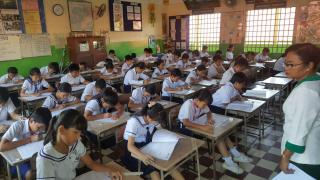
Held in the Kampot Provincial Teacher Training Center in February, EQAD assembled a diverse group of educators, with the conviction that educators from all levels of the system need to be brought into discussions on how to change practices. Following a series of sessions designed to familiarize provincial education officials and teachers with outcomes from OAA’s pilot assessments of 21st century skills, the EQAD staff worked with participants to develop assessment items for classroom use.

As the first short-term target, teachers designed items for use in monthly tests of student progress. An additional target for the monthly tests was to ensure at least one item per subject would reflect OAA’s approach of assessing 21st century skills embedded in subject curricula. Over time, this latter approach will be scaled up to support regular classroom teaching and learning.

An overarching goal of the workshop was to support teachers to move beyond the textbooks that they currently rely on to consider the curriculum more broadly. As Cambodia shifts away from reliance on rote learning, the teachers themselves need greater familiarity with the curriculum and curricular goals. The OAA assessment task structures provide exactly this facility: Not only do they require students to think beyond routine application of their learning, they model this approach to teachers.

Scaling 21st century skills

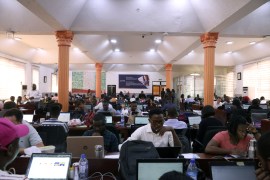
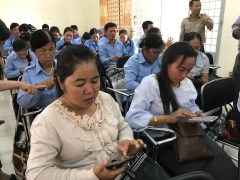
The app, Telegram, has allowed EQAD to provide just-in-time materials in their capacity-building activities. Educators can access Telegram easily on their mobile phones, download materials, chat, and send all sorts of documents and images, and thereby engage in a dynamic community characterized by quick interaction. As can be seen in the below images from the workshop, the phones provided an essential resource—unlike in many gatherings where individuals looking at their phones indicates disengagement. It was great to see the start of basic information and communications technology literacy in a Cambodian education context.

The Provincial Office of Education (PoE) staff and school directors, together with the Teacher Training Department and Primary Education Department, developed action plans to enable continuing technical item development for the school-based groups after the workshop. The plan is for the four pilot schools that participated in the OAA initiative to scale up to additional grade levels, with EQAD support, as their confidence and expertise builds. To support these activities, the schools will meet in their technical groups, one in Phnom Penh and one in Kandal Province, each month. The Telegram exchange of documents and sharing of resources will facilitate EQAD’s review of item drafts for use in the classroom as teacher expertise develops.

EQAD’s plans to share OAA procedures and practices with teacher training centers in other provinces and institutes so that both trainers and trainees can continue to build knowledge around concepts of 21st century skills assessment and incorporate it into teaching and learning. In the immediate future, EQAD will also scale up to two schools, Chaktomok Primary School in Phnom Penh and Takhmao Primary School in Kandal province. These schools will join the original four to work together to share knowledge and practices.

In many countries, we see responsibility for educational assessment separated across departments or centers, such that responsibility for large-scale testing is taken by one department, and responsibility for classroom-based assessment is taken by another. EQAD has acknowledged the importance of alignment between these different levels of assessment, and while responsible for Cambodia’s large-scale assessment, also values classroom assessment as the foundation for change in education practices. With EQAD’s work to create alignment throughout the system, as demonstrated by the workshop, the future of Cambodia’s education system looks bright.


from Brookings Topics – Global Education https://ift.tt/3aH7m4o
via IFTTT

Optimizing Assessment for All: Focus on Asia

By Esther Care, Alvin Vista, Helyn Kim

Twenty-first century skills (21CS) are now firmly entrenched as learning goals in education systems worldwide, but their actual implementation in teaching and assessment practices is lagging behind. With these learning goals—which prioritize how to get answers rather than just providing a correct response—we are facing new challenges and exploring new solutions.

The report

This report describes the collaborative activities undertaken by the Optimizing Assessment for All (OAA) project at Brookings with three countries in Asia—Cambodia, Mongolia, and Nepal—to create 21CS assessment tasks. OAA and partners worked with the countries to identify the 21CS skills that countries value, hypothesized what these skills might look like in classroom assessment tasks, and developed and piloted these tasks to ensure that teachers can use them in classrooms.

The mechanics of the activities are described in detail to illustrate the methods used in the OAA project and by the countries. Comprehensive descriptions of work over a 20-month period from 2018 to 2019 include multicountry workshops, individual in-country workshops and convenings, regional meetings hosted by the Network on Education Quality Monitoring in the Asia-Pacific, virtual communications, and maintenance of an online platform for document sharing and management.

Frequently, assessment studies focus primarily on the tools or tests. For the OAA project, the primary focus was on the process: How do you develop tasks that reflect current curricula and that integrate 21CS into teaching and learning practices?

From this process, it became clear that rethinking the classroom culture is necessary. Concerns expressed during pilot task implementation highlight some of the complexities associated with collaborative work, about not always prioritizing correct answers, and about building knowledge together.

The OAA initiative took just one step in the process of integrating 21CS into the curriculum. The development and introduction of assessment tasks in the classroom is a disruptive force acting as a lever for change. The challenge will be how to deal with that force adaptively.

Download the full report>>

Photo credit: Preah Norodom Primary School, Cambodia


from Brookings Topics – Global Education https://ift.tt/2VMc38E
via IFTTT

How skills shape the trajectory of life after school in Uganda

By Boris Bulayev, Meghan Mahoney, Hannah Ornas

Sarah’s path after graduation looks quite different from many of her classmates’ in Jinja, Uganda. Although still in her early 20s, she is a budding young entrepreneur, running two businesses while supporting her family and saving for university. Why—when many of her peers fall into youth unemployment after school—was Sarah’s trajectory different?

The answer to this question isn’t just important for Sarah and her schoolmates, it’s a broad policy issue. Africa is the world’s youngest continent, with nearly half  of its population under 18. By 2045, this demographic is expected to more than double. And by the end of the century, nearly 50 percent of the world’s children will live in Africa.

These demographics present both an enormous challenge and an incredible opportunity. Equipped with the right tools, Africa’s growing youth population has the potential to drive positive change and transform the continent’s future. To capitalize fully on this opportunity, policymakers and educators must actively seek solutions that help young women develop the tools to succeed, as girls often face additional barriers that result in lower levels of education, higher unemployment, and rigid social restrictions that perpetuate a lack of opportunity and further limit potential.

But how can we effectively equip youth with the skills to thrive in the 21st century? Educate! is a nonprofit social enterprise working to prepare youth, like Sarah, with the skills to succeed in today’s economy. Our experiential model of education teaches the transferable and soft skills demanded most by both employers and students, such as teamwork, public speaking, networking, critical thinking, self-confidence, and creativity. On top of those foundational soft skills, our curriculum also layers hard business skills.

Beginning in 2012, Educate! partnered with researchers from the University of California-Berkeley and the World Bank, and Innovations for Poverty Action to conduct a randomized controlled trial (RCT) to measure the impact of our flagship model in Uganda on program graduates four years after completion. From what we have found, this is the first study in Africa that demonstrates a causal link between a school-based soft-skill development program and improvements in life outcomes related to education and gender equity.

Educate!'s Randomized Contrl Trial ResultsCredit: Educate!

The evaluation found that the Educate! program achieved lasting, statistically significant impacts on participating youths’ soft skills. In the four years since the program, youth have translated these skill improvements into improved life outcomes in key areas, such as gender-related outcomes and educational attainment. These results were encouraging and have exciting policy implications,  as a growing body of research suggests that soft skills play a critical role in driving positive, long-term life outcomes. For young women in the program, the impact was even more pronounced, and the RCT provided important insights into how programs that target soft skills can also support young women in navigating life in the 21st century and its subsequent challenges. Based on these findings, Educate! drew a few critical conclusions.

Building soft skills can encourage youth, particularly girls, to further invest in education

Equipped with improved soft skills to navigate life’s decisions, Educate! participants propelled themselves further within their studies. The program had a statistically significant impact on secondary education completion. For young women, the impact was even greater. Moreover, the increase in likelihood of completing secondary school for young women who participated in the Educate! program was enough to virtually close the gender gap—graduation rates were 89.9 percent for women in the treatment group (compared to 83.3 percent for women in the comparison group) and 90.4 percent for men in the comparison group. Additionally, women in the treatment group were also more likely to enroll in universities or vocational schools. The program also influenced their choice of study, and female Educate! graduates were more likely to pursue technical degrees, like business and STEM majors, in university.

This research suggests that when youth, especially young women, improve skills that help them set and achieve their personal goals, they invest in themselves and their future, particularly through education. For young people in Africa, this is a logical investment, as further education will not only shape their labor market prospects but earn them sizable returns in the long term. According to a World Bank study, those who graduate from secondary school in Uganda earn 16.7 percent more than peers who complete primary alone, and those who complete tertiary earn an average of 23.4 percent more than those who finish only secondary. The returns are even higher for young women.

Soft skill development programs can also drive important life outcomes related to gender equity

Improved soft skills provide young people with a toolbox of flexible skills that can assist them in charting the course for their future and making informed decisions aligned with their goals. These skills are useful across every facet of life, including the workplace, within personal and family relationships, in school, and more. The findings of this RCT suggest that youth are leveraging the multidimensional skills gained through the Educate! program to positively influence critical life outcomes related to gender equity. The evaluation found strong and positive impacts on outcomes the researchers termed “social spillovers” for both girls and boys: reducing domestic violence, sexual partners, and number of children, and improving egalitarian views. Particularly encouraging within these results? The effects demonstrated by the evaluation are broadly comparable to some interventions that specifically target gender-related outcomes.

While the Educate! program seemed to improve girls’ ability to exercise agency within their lives, it also promoted gender equity in another key way: shifting young men’s views about the role and potential of young women. After participating in Educate!, boys expressed values and beliefs that suggest they see female peers more as equals and could help challenge some of the stereotypes that hold girls back. Male graduates were more likely to recognize women’s value and roles in society and the right to safe and consensual sex, and to engage in less risky sexual behavior. While more research is needed, these findings suggest that the Educate! program could further support young women to achieve their goals by shifting young men’s attitudes—bringing them closer to being allies in the fight for gender equity rather than adversaries.

This RCT contributes to the growing literature demonstrating the critical role soft skill development plays in helping young women act as decisionmakers in their lives and to set and achieve their own goals.

But did the program show any impacts on graduates’ employment outcomes? With many youth still in university and vocational school, it is too soon to tell. What we do know is that the impacts from Educate!’s program on skills, gender, and educational outcomes have promising implications for the future. Existing research shows that improvements in these outcomes strongly correlate with long-term labor market outcomes. While these economic impacts may need more time to materialize, the medium-term impacts suggest that youth are receiving the skills they need to improve life outcomes.

Leveraging the essential soft skills learned through the Educate! program, youth are charting a new path for themselves. Sarah launched her first enterprise and used the income to cover her school fees, enabling her to graduate secondary school and support her family. Despite her young age, the experience and skills she’s gained help her face the future confidently. “I’m the one taking care of most of my family members. It makes me happy because it means I’m responsible. If anything comes up in the future, I’m ready to deal with it.”

As implementers working within the education to employment space, we must embrace evidence that developing adolescents’ soft skills can yield positive outcomes that seep into many aspects of young people’s lives. We must collectively examine how education can set youth up for success—not just in the classroom and on exams but in life after school. The results from this RCT suggest that by focusing our efforts on redefining education systems to prepare youth with important soft skills, we can develop an empowered generation of male and female learners who are equal partners in driving positive change and begin to dismantle the societal barriers that hold girls back. By equipping this growing working-age population with the essential skills to thrive in the 21st century, we can leverage Africa’s greatest resource for change—young people—and prepare them with the skills to drive equitable and inclusive development across the continent.


from Brookings Topics – Global Education https://ift.tt/2Tf3DVy
via IFTTT

Roadblocks to quality education in a time of climate change

By Christina Kwauk

Executive Summary

In October 2018, the Intergovernmental Panel on Climate Change (IPCC) released a special report that spelled out a dire vision of the future for planet Earth if climate action around the world is not accelerated by 2030. Out of the commentary that emerged, few have championed the report’s acknowledgment that education, especially when informed by indigenous and local knowledge, can help to 1) accelerate the wide-scale behavioral change needed for an equitable system-wide transition to a carbon neutral economy, and 2) build competencies and knowledge to enhance innovation and the policy and technological adaptation required to limit global warming to 1.5°C.

The lack of education champions within the global climate “policyscape” is fueled in part by an overemphasis of political attention and financial resources—when attention and resources are given at all—toward efforts to reduce greenhouse gas emissions. At the same time, the global education community’s attention and resources have been fractured by many development priorities, diluting the efficacy of its power to be a gamechanger in climate action.

The urgency of the climate crisis demands not only greater coherence and coordination of education efforts, but also a deep reexamination of the education sector’s role in the perpetuation of the status quo. This applies across formal education institutions (primary, secondary, and tertiary school), nonformal programs (often delivered by nongovernmental or community-based organizations), and informal spaces (on the radio, in libraries, museums, or even grocery stores and bus stops). It also demands attention from children, youth, and adults in both high-carbon emitting and low-carbon emitting countries, as well as within and across sectors (e.g., education, energy, transportation, agriculture, and urban planning).

As a starting point for critical discussion among education and noneducation actors, this paper focuses on formal education spaces where coordinating local efforts across districts, states, and nations can have impact on a global scale. First, the paper illustrates why more attention to and investment in education as a means of reducing risk and increasing informed action to climate change is needed, lest the technofixes of today lack political will and localized solutions for sustained, collective climate change action in the future. Second, it describes the current policy landscape for education in climate action, and climate in education. Third, the paper presents five underlying challenges preventing the formal education sector from taking a more proactive role in climate action. These roadblocks can then become entry points for policy and action. Finally, the paper lays out three actions that education and climate actors can take to not only chart a roadmap for the education sector in climate action, but to generate a new set of game-changing rules.

DOWNLOAD THE PAPER >>

Note: In this paper, the term “global education community” is used to loosely describe the sum of education actors globally (civil society organizations, nongovernmental organizations [NGOs], government ministries, activists and advocates, etc.). The term does not imply that this collective set of actors views themselves as a single, cohesive community. The term “education sector” is used to describe the systems of education delivery (schools, school systems, ministries of education, etc.), while “education” refers to the process of teaching and learning. 


from Brookings Topics – Global Education https://ift.tt/391lrJj
via IFTTT

Figures of the week: Public spending on education in Africa

By Dhruv Gandhi

In January, the African Development Bank (AfDB) released the African Economic Outlook 2020, its annual publication that reviews Africa’s growth performance. This year’s edition includes a special section on workforce development in Africa. According to AfDB estimates, the region grew at 3.4 percent in 2019 and is expected to grow at 3.9 percent in 2020. Growth in 2019 was about the same as the year before. Africa’s five largest economies (Algeria, Egypt, Morocco, Nigeria, and South Africa) have dragged down region-wide growth as they expanded by 3.1 percent compared to 4 percent for the rest of Africa. East Africa was the fastest-growing region with 5 percent growth.

The effect of government spending on education in Africa is mixed

The report highlights the education and skills needed for the future and how governments can finance investments in education. Currently, African governments spend about 5 percent of GDP on education, which is the second highest of any region. Notably, almost half of all African countries are meeting both of the recommended education financing targets set by the United Nations (Figure 1). The effect of government spending on education in Africa is mixed: Higher absolute spending is positively correlated with average years of schooling but has no relationship with test scores (a proxy for education quality).

Figure 1. While many African countries met at least one of the two education financing targets, only 46 percent met both targets, 2010-2017

Figure 1. While many African countries met at least one of the two education financing targets, only 46 percent met both targets, 2010-2017

Source: African Economic Outlook 2020, African Development Bank.

While African countries are devoting significant resources to education, the region has the worst education spending efficiency. According to the report, Africa has a 58 percent efficiency score for primary education and 41 percent efficiency for secondary education, both more than 20 percentage points lower than the second-worst performing region (Figure 2). According to the report, if public spending efficiency in Africa were at the level of Latin America, the region’s primary school completion rate would rise from 79 percent to 98 percent. Within Africa, Southern Africa has the highest education spending efficiency.

Figure 2. The efficiency of government education spending on primary and secondary education is lowest in Africa, 2010–2018

Figure 2. The efficiency of government education spending on primary and secondary education is lowest in Africa, 2010–2018

Source: African Economic Outlook 2020, African Development Bank.

The report provides recommendations on how governments can improve education spending efficiency and mobilize additional resources, as the region currently faces an annual $40 billion gap in education financing. On efficiency, the report recommends strengthening Public Expenditure Tracking Surveys, using performance-based financing to improve outcomes, and raising teacher quality to reduce school repetition. For additional financing, the report highlights the potential of public-private partnerships—such as implementing service contracts for schools and increasing private financing of research—and increasing private sector involvement in vocation-training programs.


from Brookings Topics – Global Education https://ift.tt/2OSKINR
via IFTTT

Rethinking the critical role of data to improve teaching and learning

By Reinier Terwindt, Emily Gustafsson-Wright, Jenny Perlman Robinson

With 258 million children out of school and 617 million children and adolescents in school but not achieving minimum proficiency levels in reading and math, we are rapidly running out of time to achieve Sustainable Development Goal (SDG) 4 by 2030: ensuring quality education and lifelong learning opportunities for all children.

The global education sector faces the dual challenge of improving learning at scale and measuring whether we’re on track. To address the scope of the learning crisis, we must identify innovations that have the potential to improve learning in a manner that is sustainable, equitable, and cost-effective, and then understand how to scale these innovations in a given context.

For several reasons, data is a crucial piece of the puzzle. First, data can provide insights on program effectiveness, allowing governments and donors to identify, finance, and scale the most effective interventions. However, data is not just about final project outcomes: Collecting information about implementation in real-time, and creating feedback loops to decisionmakers, allows for adaptation and improvement. In the global education sector, we tend to spend resources on trying to perfect our innovations before they’re carefully evaluated, which can mean that the most powerful insights come far too late. Instead, stakeholders need to use data and insights to iterate and pivot quickly—highlighting the importance of collecting the right kinds of data.

How we are working with data to improve teaching and learning

We at the Center for Universal Education (CUE) and STiR Education heavily rely on data to improve learning at scale and measure progress in our areas of research. While data and information systems are central to informing our work, we employ them in distinct ways. Below we share our unique approaches to promoting quality education for all through data collection and use.

STiR: Using “thick” and “thin” data to motivate education officials and teachers

STiR Education partners with governments to reignite intrinsic motivation and lifelong learning among government officials, teachers, and students, impacting more than 200,000 teachers and 6 million children in India and Uganda.

STiR implements a radically different approach to monitoring, evaluation, and learning using a combination of “thin” and “thick” data. By thin data, we mean observable outputs and outcomes, whereas thick data refers to the description of processes. We focus not just on collecting outcome data for the sake of accountability (e.g., are teachers showing up to class or are students passing their exams?) but also on stimulating discussion among officials and teachers using thick data, which motivates them to further drive behavior change.

Thick data could include feedback that an official provides to a teacher, the consequent change in teaching practice, and the extent that students trust their teacher and are engaged in learning. This type of data tends to be more motivating for officials and teachers compared to more traditional thin outcome measures for two reasons. First, it helps them to better understand progress toward improving common outcome indicators—such as whether students are passing their exams—by showing the underlying steps toward this (e.g., do students feel safe in the classroom and are they engaged in learning?). Second, it tends to be more actionable, so that teachers and officials understand what they could do differently in their classrooms and/or district offices to improve lifelong learning.

By measuring both thin and thick data rapidly at large scale, STiR aims to equip education officials and teachers with the type of information that simultaneously tells us whether progress is being made toward intended behavior change and how to improve based on these insights. Currently, STiR is building a data system based around a mobile app that will share both thick and thin data with teachers and officials on a monthly basis to provide actionable, real-time guidance on improving student learning.

CUE: Using real-time data for scaling and achieving education outcomes

CUE pursues two different lines of work uniquely concentrated on data. The Millions Learning project focuses on how to scale and sustain quality education initiatives, especially for marginalized children and young people. The Real-time Scaling Labs—a collaborative effort with local institutions and governments in a number of low- and middle-income countries—seeks to generate evidence and provide practical recommendations around the process of scaling. Using real-time data to guide the scaling process, CUE and partners are putting the important principles of iteration and adaptation into practice.

CUE also focuses on the collection, analysis, and use of data to achieve outcomes in early childhood development and education—centered around four key types of data: real-time performance, results, cost of service delivery, and cost of inaction. We are particularly interested in how technology can help gather and analyze real-time performance data.

This focus emerged from several years of work studying outcome-based financing, and in particular, impact bonds. To participate in outcome-based financing structures, service providers need accurate real-time performance data to effectively adapt performance and meet targets. While interest in improving performance management has grown over the last few years, so too has the availability of technology. This has resulted in a wide variety of new technological tools and platforms for collecting, analyzing, and integrating data into education. CUE is investigating the landscape of existing technological tools for data collection and use in education, with the goal of providing decisionmakers with robust evidence and practical guidance about the use of data in achieving education outcomes.

STiR’s and CUE’s complementary work highlight the central role of data for achieving SDG 4, the potential for technology to facilitate data collection and analysis, and the use of data to support scaling. While we use data in distinct ways, our work showcases the need to think differently about monitoring, evaluation, and learning, and to integrate real-time data into decisionmaking.


from Brookings Topics – Global Education https://ift.tt/2Og79fI
via IFTTT

Computer science can help Africans develop skills of the future

By Rebecca Winthrop, Lauren Ziegler

The world is well into the Fourth Industrial Revolution, and yet education systems have not kept pace. Young people are often not learning the skills they need to succeed in the 21st century and interact with their changing world, such as digital literacy, problem solving, and critical thinking. Despite widespread recognition of the importance of these skills for the future in education policies, very few education systems have adapted to this reality. On the African continent, where 60 percent of the population is under age 25, the teaching of 21st century skills will be necessary for Africa to transform itself into a continent of growth and opportunity. If young people do not learn how to use and create with technology, they are sure to fall further behind.

How can Africa harness the power of technology when only 24 percent of Africans have access to the internet? Despite gains in internet access over the last several years, the region lags behind the rest of world in internet usage. A Pew survey of six African countries finds that internet usage is high among youth, which is good news for schools as it will help them teach 21st century skills; however, the study also finds that internet users tend to be male and have higher incomes and more education, meaning that more needs to be done to ensure all young people, no matter their gender or socioeconomic status, develop skills that enable their future success.

Education systems need to equip their students with basic tech proficiency and, going further, enable students to create with technology.

Education systems need to equip their students with basic tech proficiency and, going further, enable students to create with technology. The Center for Universal Education (CUE) at Brookings is interested in how education systems can foster the development of skills for the future through computer science (CS). (Many similar and related terms exist such as computing, informatics, computational thinking, and coding. We’ve used computer

science here, but the specific term is less important than whether students are learning and understanding how computers work.) CS education helps students understand how computers work, use algorithms to create computer programs and apps, and work with their peers to solve complex issues. Given that computers are all around us and technological advances are disrupting every industry, knowing how to use them will be beneficial to anyone, whether or not they wish to become a computer scientist.

Already, there are many examples of CS education taking place in Africa. For example, the Ghana Code Club is a weekly after-school coding club that has trained more than 1,700 students and 300 teachers across 100 centers, and Teencoders, based in Nigeria, has reached over 5,000 students through after-school and weekend coding classes. While these nonformal education programs give learners critical exposure to the discipline, expanding CS education into formal primary and secondary schooling can ensure that many more young people learn computer science concepts.

One potentially promising way to overcome resource constraints is to teach without a computer.

Certainly, many constraints exist, including funding for equipment, lack of trained teachers, and lack of time during the school day to teach CS given other curricular priorities. One potentially promising way to overcome resource constraints is to teach without a computer. The platform CS Unplugged uses worksheets, magic tricks, art projects, and games to teach students computer science concepts offline. In one lesson, students learn about the binary system by creating a beaded necklace with their initials in binary numbers. While the teacher will need internet access to obtain the materials, these activities work well in cases where there are few computers in the classroom or intermittent internet access. A forthcoming CUE study looks further at the barriers to expanding CS education with the goal of uncovering models around the world that have succeeded despite various constraints.

As the examples of Ghana Code Club, Teencoders, and others show, many already recognize the need for young Africans to learn computer science. However, more needs to be done to ensure that all students have the opportunity to learn these concepts and to develop skills of the future.


from Brookings Topics – Global Education https://ift.tt/2TZjeJR
via IFTTT

Scaling quality education calls for scaling effective teacher professional development

By Molly Curtiss, Jenny Perlman Robinson

January 24th marks the annual International Day of Education—a moment to reaffirm our global commitment to the rights of every child to a quality education. Teachers are perhaps the most important actor in a child’s education—a significant body of research demonstrates that high-quality teaching is one of the biggest factors impacting student learning. In the United States, for example, studies have found that the differences between a good and a bad teacher can equate to a full year of learning for a student. Quality teaching also can play a role in improving equity, as “several years of outstanding teaching may in fact offset learning deficits of disadvantaged students.”

This means that the quality and effectiveness of education, training, and continuous professional development for teachers and other members of the education workforce should be a top priority for those working to strengthen quality learning opportunities for all. The outsized impact of teachers on student learning makes it clear that successfully improving learning outcomes at scale will require reckoning with how to scale teacher professional development (TPD) in an effective, efficient, and equitable way. As a global education community, we need to learn more about how to sustainably scale quality teacher training opportunities; otherwise, we risk stymying efforts to scale improved learning outcomes more generally.

Addressing challenges in scaling effective teacher professional development

There is a marked gap between what evidence suggests makes for effective teacher professional development and the realities of many TPD programs around the world. A compounding challenge is that many elements of quality professional development that lead to impact at a small-scale can present real challenges when implemented at large scale. Analysis of good practices in delivering effective TPD reveals common issues when scaling and potential ways to address them:

  • Costs. Unsurprisingly, one of the biggest challenges faced is costs. More traditional methods of implementing and scaling teacher training—such as centralized seminar-style courses—are often less expensive than more personalized and intensive approaches that have demonstrated stronger impact. Further, we know that costs of delivery often increase when scaling to remote or disadvantaged regions. On face value, many models may be considered simply too expensive for large scale. However, cost-effectiveness, not cost alone, must be considered, as it is pointless to invest scarce resources to scale a program that has little effect. In some cases, implementing a cost-effective model more slowly (such as in stages) might make more sense than rapidly implementing less effective training for all.
  • Maintenance of quality. Another critical challenge is the maintenance of quality at large scale (an issue which certainly transcends teacher training). This challenge is seen across numerous TPD models, from the dilution of quality frequently observed at each level of a training cascade, to the challenge of finding qualified and motivated coaches and matching them with teachers at large scale. As a result, many teacher training models have demonstrated diminishing returns as they expand, facing challenges that were much less evident when working at smaller scale. One key component to maintaining quality during scaling is building ongoing and rigorous monitoring into TPD at every stage, assessing not just teacher knowledge acquisition or the number of individuals trained, but also the transfer of knowledge to practice in the classroom and the effects on student learning outcomes. This data should be used not just for accountability, but also for identifying challenges and informing decisions about how to address them.
  • Identification and training of high-quality trainers, facilitators, and coaches. A third challenge is identifying and training the individuals who will implement the training itself. Just as the quality of teachers impacts student learning outcomes, the quality of the trainers, facilitators, and coaches strongly impacts the effectiveness of training and professional development. This requires careful consideration of the selection criteria, recruitment process, and training of these personnel when designing a training program and planning for scale, including a clear understanding of the knowledge and skills the trainers or coaches must have to effectively train others (an area where more research is needed.)
  • Contextualization and addressing variation across contexts. A further challenge is balancing the need to adapt the training content and approach to the local context, while still maintaining essential elements. Evidence shows TPD programs should have the flexibility to address variations in participants’ experiences; however, this personalization also presents challenges at large scale. For example, engaging teachers in course content design can be costlier at large scale, and some of the economies of scale of a standardized curriculum are lost. As such, balancing fidelity to the “non-negotiables” of the training while building in opportunities for adaptation must be carefully considered, including exploring innovative and cost-effective methods for keeping teachers directly engaged and tailoring content to address their needs.

Case of the Philippines: Early Language, Literacy, and Numeracy Digital

There are numerous models and approaches to teacher training and professional development—ranging from coaching to professional learning communities to digital courses—and these models are not mutually exclusive. One method for mitigating the potential challenges of sustainably scaling specific models is to pursue a mixed-model approach, combining lower cost and more scalable components with more intensive and potentially higher impact elements.

One example of a mixed-model, technology-mediated approach to transforming TPD is in the Philippines, where local NGO FIT-ED and the Philippine Department of Education are collaborating to scale a blended teacher professional development program for K-3 teachers in more than 36,000 public elementary schools across the country. The program, Early Language, Literacy and Numeracy (ELLN) Digital, has two components: (1) interactive multimedia courseware designed for self-study offline and (2) school-based, face-to-face collaborative learning groups. Perhaps the most innovative aspect is how the Department of Education has introduced rapid cycles of learning to test and gather quick information on the scaling process, to ensure that ELLN Digital continues to be effective as it reaches more and more teachers.

As part of the Millions Learning Real-time Scaling Labs, the Center for Universal Education at Brookings is collaborating with the Teacher Professional Development at Scale (TPD@Scale) Coalition for the Global South, through direct engagement with FIT-ED, the Coalition’s Secretariat, to draw key insights and recommendations from the experience of scaling ELLN Digital in the Philippines. Some of the insights shared in this blog have been informed by the important work of the Coalition, including a forthcoming landscape review on TPD programs at scale in the global south.

There is much to learn about this process of introducing a change into the existing system—in this case quality TPD—with the intention that it becomes the “new normal” sustained by an ecosystem of local actors. We expect further insights from the TPD@Scale Coalition’s work will be useful for other countries looking to improve the quality of their TPD programs, as well as to inform efforts to scale education innovations more broadly. Increasing the number of well-trained and supported teachers who can deliver new content, knowledge, and approaches is mission critical to realizing International Day of Education’s goal of ensuring a quality education for all.

Note: This work was carried out with the aid of a grant from the International Development Research Centre, Canada to the Foundation for Information Technology Education and Development (FIT-ED). The views expressed in this work are those of the authors and do not necessarily represent those of the International Development Research Centre, Canada or its Board of Governors; or the Foundation for Information Technology Education and Development.


from Brookings Topics – Global Education https://ift.tt/2tyNhNL
via IFTTT

Optimizing Assessment for All: Framework for understanding project goals and scope

By Esther Care, Helyn Kim

In a world of rapid advancement and change, people and societies need a new mixture of skills to thrive. It is no longer accepted that education devoted mainly to the memorization of facts will prepare people to be thoughtful, productive, and engaged citizens. Rather, people of all ages need a broad set of skills, including cognitive, social, and technological, to evaluate and apply knowledge in ways that meet the new demands of a changing social and economic landscape. These skills, such as critical thinking, problem solving, collaboration, information literacy, and communication, among others, are often broadly referred to as 21st century skills (21CS) or transversal competencies.

Despite increasing global emphasis on measuring learning—with more than 170 countries participating in some type of national, regional, or international assessment—results are not often used in ways that promote student learning. Moreover, countries around the world are including 21CS in their national education goals and policies, signaling their commitment to addressing the changing needs of their learners. However, countries are faced with challenges on how to implement these policies due to disconnects between different parts of the education systems; lack of understanding on how teaching and learning 21CS looks in the classroom; and limited measurement expertise in the area of 21CS assessment.

Between December 2017 and April 2020, the Optimizing Assessment for All (OAA) project will address these challenges by strengthening education systems’ capacity to integrate 21CS into their teaching and learning, using assessment as a lever for changing classroom practices and building that capacity. In this project, 21CS are defined as domain-general skills (cutting across multiple domains of knowledge), which are becoming increasingly important in our 21st century world and its diverse work environments. A central project objective has been shifting attitudes toward the constructive use of assessment to support learning for all. In addition, the project has been based on the premise that many countries are confronted with similar challenges and issues around how 21CS are taught and learned in classroom settings and how education systems can support this process. OAA has taken a ground-up, collaborative learning approach where countries work together to find solutions for developing and using assessment approaches that target 21CS and build their own capacity, rather than relying on external experts.

The OAA project has emphasized developing existing capacity and resources and changing mindsets to cultivate and support a new generation of assessment specialists within the participating countries and regions. OAA has worked in two regions—Asia and sub-Saharan Africa—and three focus countries within each region have participated in a capacity-building approach for designing, developing, and piloting classroom-based assessments of 21CS.

The reports

Following publication of this initial framework, four additional reports will publish throughout the winter and spring of 2020 expanding upon the topline information outlined here. These publications will include: a focus on Asia and Africa, describing the OAA activities in each region, and the slightly different approaches taken between the two; examples of 21CS assessment tasks with explanations on how teachers can use them and develop their own tools; and a system-level guide on policy pathways for countries integrating 21CS.

Download the full report>>


from Brookings Topics – Global Education https://ift.tt/36gLsCn
via IFTTT