Rethinking the traditional textbook for better academic and pro-social outcomes

By Andy Smart, Esther Care

In the first of our NISSEM global briefs blogs highlighting the role of textbooks for enhancing learning outcomes, we focused on the need for textbooks to be aligned with the mission and vision of the Sustainable Development Goals, and in particular Target 4.7, which calls for ensuring all learners acquire knowledge and skills needed to promote sustainable development. This second post explores how textbooks for basic education levels can be optimized to integrate both pedagogy and content.

In low- and middle-income countries, the textbook has the weight and imprint of authority—especially when the same book is used by all students throughout the country and teachers are obliged to cover its contents from first to last page. But, if laden with definitions and written in high-level language, the textbook can be a barrier to learning, a burden on teachers, and an amplifier of inequity (Table 1).

Table 1. Textbooks: from barriers to carriers

Learning barriers and carriers

Can these barriers be reshaped around the principles of different perspectives, collaboration, and recognition of diversity, while also supporting cognitive and pro-social learning—even in low- and middle-income countries?

Thinking about the textbook as an amalgam of content and pedagogy—including beliefs about the process of learning in general, as well as within a particular subject and level—can help curriculum and textbook writers address these barriers. In most subjects, the themes and values of Target 4.7, as well as social and emotional learning (SEL), can be expressed as both content and pedagogy. A textbook—whether for math, language, science, or social studies—can be developed and analyzed according to these two dimensions.

In Figure 1, which can represent a starting point for curriculum and textbook developers, there is an axis for pedagogy and another for content: A textbook that is strongly supportive both of pedagogy and content aligned with the social-emotional skills signified by SDG Target 4.7 would be located in the top right quadrant.

Figure 1. Starting points for supportive pedagogy and content

Pedagogy and content

Supportive content and pedagogy

In the NISSEM Global Briefs, blog author Andy Smart provides examples of structured pedagogy within new textbooks for the competency-based curriculum in Bangladesh: each double-page spread presents the curriculum content on the left-hand page, with the right-hand page structured around “Speak” (whole class), “Write” (often in pairs), “Extend” (individual or groups) and “Check.” In the new competency-based textbooks in South Sudan, as described by Vikki Pendry, three principles are followed, which closely link pedagogy to cognitive concepts:

o   One learning activity leads to many learning outcomes

o   One learning outcome requires a number of learning activities

o   Each learning outcome should be part of a carefully constructed sequence of learning.

In Poonam Batra’s paper, new civics textbooks in India made the social world of the learner both an object of study and a process of constantly getting learners to reflect upon their own social experiences, thereby encouraging diversity and inclusion.

Creating an effective textbook

In low- and middle-income countries, these SEL and Target 4.7 themes, values, and skills should be essential dimensions of the cognitive curriculum rather than supplementary lessons. Textbook writers should embed these dimensions within an organizational framework that is built on academic coherence. The NISSEM position paper proposes that in low- and middle-income countries, embedding a 4.7/SEL approach within the core curriculum is more effective in contrast to the standalone SEL programs implemented in OECD countries. In this way, an SEL-based approach is made sustainable and will not become a victim of reduced program funding. Framing a SEL/4.7 approach within a strong cognitive curriculum or textbook plan ensures an appropriate balance of academic, social, and emotional dimensions.

After planning a textbook on the above model of content and pedagogy, writers can avoid creating barriers of high-level language, which may be exacerbated by the language of instruction, and overly dense texts. One of the most widely quoted studies of textbook effectiveness in low- and middle-income countries found that only the highest-attaining students saw any benefit from providing textbooks because the books were in the students’ second language of English.

Typically, lessons in many low- and middle-income country schools are neither teacher-centered nor student-centered; rather, they are textbook-centered, in which the time-poor teacher has little recourse other than to drill students in a text they have little hope of understanding. Additionally, teachers’ own experiences must be taken into account. Textbook reforms cannot succeed without the support of teachers. In their global briefs, Basel Akar and Nayla Hamadeh describe how teachers have collaborated with ministry of education colleagues to transform pedagogy, even where curriculum reform has stagnated for political reasons.

NISSEM advocates for learner-centered pedagogy as long as teachers’ views are taken into account, and for teacher-centered pedagogy as long as students’ views are taken into account. The content for textbooks, including contextualizing SEL priorities, can be generated or tested through focus group meetings with key stakeholders. Among these stakeholders should be former students who have recently completed their education, as well as older youth—whether in work or not—who can testify to the aspects of their education that were personally valuable. Such field-tested content, along with a 4.7/SEL pedagogy, will enable curriculum and textbook reforms for basic, compulsory schooling to produce an exciting, new, and powerful generation of 4.7/SEL-informed textbooks.


from Brookings Topics – Global Education https://ift.tt/35MwLYz
via IFTTT

Charts of the Week: Gender and education

By Fred Dews, Tamari Dzotsenidze

Brooking scholars have done extensive research on policy issues focused on women and girls, especially in education. In observance of United Nations’ International Day of the Girl Child, here are some charts highlighting some issues where gender and education intersect. Visit the Center for Universal Education for the latest research on girls’ education 

GIRLS ARE DISADVANTAGED IN SECONDARY SCHOOL GLOBALLY 

Rebecca Winthrop, director of the Center for Universal Education, and Eileen McGivney studied disadvantages faced by girls attending secondary school. Analyzing 2012 data, they found that while in 51 countries girls outpaced boys in secondary school enrollment, in 56 countries girls lagged boys, while in an additional 23 countries girls were severely disadvantaged in enrollment. This means that despite both boys and girls experiencing enrollment disadvantage in about the same number of countries, the number of countries in which girls are severely disadvantaged is nearly quadruple those in which boys are severely disadvantaged. Winthrop and McGivney identified these “girls’ education hotspots” across Asia and sub-Saharan Africa where, they note, many girls are married before 18, struggle with enrollment, “and in at least 15 countries [face] attacks on their lives for participating in education.”

Map2-SecondaryGpi.gif

MORE FEMALE STEM TEACHERS MAY INCREASE GENDER EQUALITY IN STEM 

Michael Hansen, director of the Brown Center on Education Policy, and Diana Quintero  examined whether increasing numbers of female teachers disadvantage boys in the education system. They found that while research shows that the presence of female professors results in higher grades and enrollment for female science, technology, engineering, and math (STEM) students, there is no research that suggests that this has a negative effect on male participation or outcomes. “In other words,” Hansen and Quintero wrote, “having more women leading math and science K-12 classrooms could actually be a preferred strategy to promote more gender equity in workforce outcomes.”

map_femaleteachers_2012

IDENTIFYING THREE TYPES OF GENDER EDUCATION INEQUALITY 

Elizabeth King, a nonresident senior fellow with the Center for Universal Education, examined three types of global gender education inequalities, and outlined four  obstacles to improving girls’ education worldwide. She argued that both direct and indirect costs of attending school are higher for girls, and that social norms and expectations including marriage keep girls out of school. In order to address these inequalities, there must be gender-based systemic reform.  


from Brookings Topics – Global Education https://ift.tt/35EC8c8
via IFTTT

Barriers to STEM education for rural girls

By Nasrin Siddiqa

As one of the world’s fastest-growing economies, Bangladesh aims to become a middle-income country by 2021 and a high-income country by 2041. To attain these goals, the country must face global challenges head on by strengthening existing industries and preparing itself for industries that have yet to emerge. To do this, it

must tap the full potential of its human capital. Although Bangladesh made strides in access to education during the Millennium Development Goals era, poor girls continue to fall behind despite their ambitions to lead the country to change—a gap that affects their work outcomes once they leave school. The skills that Bangladesh’s youth need to thrive in a world of rapid technological advancement will require a response by policymakers and practitioners alike.

In this video, Nasrin Siddiqa, 2019 Echidna Global Scholar, discusses how STEM education can help girls—and in particular, rural girls—develop every day transferrable skills to help them succeed in a changing, competitive job environment.

This policy paper unveils the barriers to educational opportunities for rural girls in Bangladesh, focusing specifically on science, technology, engineering, and mathematics (STEM) education. It reflects upon a survey of 500 rural secondary-level schoolgirls, 100 parents, and 75 teachers from 30 rural schools of the district of Gazipur. The study identified barriers to STEM education at three levels—individual, institutional, and societal—that revealed both systemic and socio-cultural issues that actors in policy and practice can tackle. It provides clear recommendations for action and examples of practices that have started to fill the gap globally. If Bangladesh is to accomplish its goals and tap the potential of all its youth for rapid development, breaking the barriers to STEM education for all children is a key place to start.

DOWNLOAD POLICY BRIEF HERE >>


from Brookings Topics – Global Education https://ift.tt/2VJRGqP
via IFTTT

India’s policy on early childhood education

By Samyukta Subramanian

The Delhi government in India recently launched its preschool curriculum for the city’s 10,897 community-based preschool centers. The draft National Education Policy of India, made public in June 2019, dedicates its first chapter to the importance of early childhood care and education and the need to extend the right to education to every child who is three to six years old.

In this video, Samyukta Subramanian, 2019 Echidna Global Scholar, discusses how we must tackle gender inequality in India in the early years through engaging girls, boys, teachers, and parents. 

It is in this context that this paper urges the government to ensure that gender sensitivity is embedded in every initiative of early childhood education (ECE) in India from here onward. Based on interviews with mothers of preschool children in underresourced communities and with teachers as well as observations of government-supported preschool centers, this paper builds the current narrative of the preschool child’s ecosystem; notes the lack of gender-sensitive pedagogy in this space; and makes recommendations for what a gender-transformative approach in ECE in India should entail for men and boys, girls and women, so that India can strive for a more gender-equitable society in the years to come.

DOWNLOAD POLICY BRIEF HERE>>


from Brookings Topics – Global Education https://ift.tt/2OS7shJ
via IFTTT

Girls’ transitions to work through higher-quality TVET programs in Nepal

By Anil Paudel

Education is not just about earning degrees; it is much more than that. For decades, global and national development discussions have emphasized education as a powerful tool for poverty reduction, economic growth, and human well-being. Global policies like the United Nations’ Millennium Development Goals (MDGs) and Sustainable Development Goals (SDGs) as well as national education sector plans reflect this widespread belief. However, poverty reduction and economic growth are also about earnings and making a living. As such, the school-to-work or education-to-employment transition becomes critical for realizing education’s potential inreducing poverty and thus should be closely tracked.

In this video, Anil Paudel, 2019 Echidna Global Scholar, discusses the importance of  investing in a gender-transformative TVET education to help improve girls’ real-world employability.

In Nepal, although education is a priority for all stakeholders—from students and parents to policymakers and employers—they have varying expectations on the promise of education. Students and parents expect education to provide better life outcomes, particularly successful employment and a decent living. Meanwhile, employers expect education to produce a workforce-ready population. But neither group is getting the outcomes they expect. Sadly, the education system has placed little emphasis on technical and vocational education and training (TVET), widely considered by international development agencies as an important tool in strengthening the school-to-work transition, especially when basic education does not adequately prepare

youth for the world of work.

Access to TVET is very limited  and additional barriers make it harder for girls to participate in TVET programs. Despite the country’s remarkable progress in enrolling girls in school, dropping out remains a problem. And, although boys and girls in Nepal are almost equally likely to drop out from school, boys benefit more from the choices offered by TVET and from the economic opportunities both domestically and overseas.

This paper seeks to increase understanding of how to improve girls’ and young women’s participation in TVET and to help strengthen the bridge between their education and employment.


from Brookings Topics – Global Education https://ift.tt/2VIINNU
via IFTTT

To ensure a gender-transformative approach in the early years, India must engage parents and teachers

By Samyukta Subramanian

Now is a pivotal moment for early childhood education (ECE) in India. India’s draft National Education Policy (NEP), made public in June 2019, dedicates its first chapter to the importance of early childhood care and education and the need to extend the right to education to children ages three to six. The policy does not, however, address equity and inclusiveness in the early years with respect to gender. Currently, the policy takes a gender-blind approach and overlooks the need for gender-sensitive pedagogies or to challenge gender stereotypes in class or at home. This lack of attention to gender in the early years risks missing a critical opportunity to address harmful gender stereotypes that fuel gender-based violence and discrimination plaguing the country today.

There is scant research in India that systematically documents the early childhood learning environment in homes and schools regarding prevalent gender inequalities and norms. To address this gender gap in ECE, my forthcoming research as a 2019 Echidna Global Scholar explores gendered realities in the child’s early years and outlines concrete steps to promote gender transformation in early childhood.

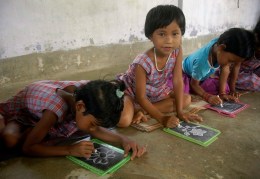
Preschoolers spend most of their time at home with mothers, siblings, grandparents, and other family members, as well as in class with teachers and children of the same age. Notions of gender inequality are carved out in the interactions that take place in the interconnected spaces of home and school. Through interviews with mothers and teachers of preschool children in under-resourced communities, as well as observations of government-supported preschool centers, my research highlights the gendered narrative of the Indian preschool child’s educational ecosystem.

My research

During the semi-structured interviews with mothers—to my delight—I found evidence of a positive shift in the mindset of mothers of preschool children in Delhi, India. Almost all mothers considered girls and boys “equal.” They wanted their children to attend school, and regardless of gender, to get a job after school and choose a professional career as an adult. The mothers’ ability to articulate gender equality is an encouraging first step toward achieving it. However, when asked where their young preschool girls played, most mothers reported that their girls tended to play inside the home, while boys played outside, not realizing the irony of the statement when it comes to perpetuating gender stereotypes. One mother stated: “The games for boys and girls are different. Boys play cricket and like running, while girls play hide-and-seek. Girls understand household work, while boys must work outside and need more physical strength.” The same mother, however, stated that girls and boys should be treated as equals, again clearly demonstrating the gap between mothers’ articulation of gender equality between boys and girls and gender stereotypical practices.

Teachers, too, showed gendered expectations of children in class and at home. Preschool teachers stated that boys are generally naughtier than girls in the classroom; though they could not say why, they insisted this held true for all children they taught. When children parroted the gender stereotypical roles they witnessed at home in class, teachers accepted it without question. Teachers did not recognize how play, stories, songs, and other preschool activities shape stereotypes that can influence educational, occupational, and social outcomes. This underscores the need to raise awareness about gender stereotypes with preschool teachers while also equipping them with the tools to address assumptions around traditionally held gender norms in class.

Lessons learned

Two clear lessons emerged from my research: First, we must take an ecosystems approach to ECE, working with children but most importantly adults. Both parents and teachers must be sensitized for young children to develop gender equitable attitudes and behavior.

Second, changing parents’ views on traditional gender roles will require clear channels of communication and constant dialogue, which can occur through leveraging preschool teachers and digital platforms that parents can access. Teachers need to move away from the traditional “chalk and talk” role to instead nurture in the classroom and become the bridge between the child and his/her parents. They can question gender stereotypical assumptions with children and gendered expectations with parents. On the digital platform front, my research found that even in under-resourced communities, there were smart phones and television sets in every home. Using these platforms to communicate with parents could provide exposure to diverse role models and challenge traditionally held gendered notions to change behavioral practices at home.

A gender-transformative approach tackles the root causes of gender inequality and reshapes unequal power relations by working at individual, familial, and institutional levels. If we do not take a gender-transformative approach to early childhood in India by engaging girls, boys, teachers, and parents now, we won’t cut the roots of gender-based violence and discrimination before the next generation comes of age.


from Brookings Topics – Global Education https://ift.tt/2MJzYQ9
via IFTTT

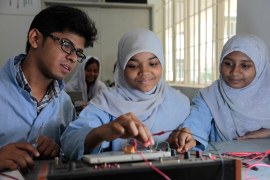
Beyond labs and numbers: STEM’s role in girls’ skills development in Bangladesh

By Nasrin Siddiqa

Over the last decades, Bangladesh has seen annual GDP growth rates rise due to the arrival of the garment industry. Girls and women from all over the country flooded Dhaka in search of work, and in turn, revolutionized women’s roles as economic players. Years later, the industry is threatened by automation and globalization. While around 80-85 percent of the garment industry is comprised of women, it is the men who have leadership role in factories across the country. The girls and women of Bangladesh can offer much more, and STEM education can help lead the way.

Bangladesh has committed to reaching middle-income country status by 2021 and high-income country status by 2041, but the pathways to achieving this are unclear. Cities have a mass of educated job seekers, but it’s very difficult for rural, underprivileged girls to compete in the labor market. These girls lack basic digital skills and—perhaps more importantly—transferable skills that would equip them to thrive in a changing age of work.

As an NGO leader, science teacher, and school administrator in the last 20 years of my career, I have seen firsthand the talent of adolescent rural girls in communities across the country. The science, technology, engineering, and mathematics fields will be key if girls are to learn important skills like collaboration, problem solving, and critical thinking. Girls have both the talent and ambition to lead in STEM fields, yet they lag behind. I wanted to find out why.

My research

In my research, I interviewed and surveyed over 700 stakeholders—500 girls, 30 administrators, 75 teachers, and 100 parents. I sought to understand why STEM is dominated by men and how that starts in communities and classrooms. A common social belief is that girls are not interested in STEM or that boys are inherently capable of critical problem solving and math. Through my soon to be published research as an Echidna Global Scholar, I have disproved these harmful assumptions.

My research found that the problem lies with our infrastructural, institutional, societal barriers—some of which are visible, others which remain hard to detect. Norms, systems, and attitudes reflect a deeply patriarchal society that not only keeps girls from participating in the subject matter but limits their access to key learning opportunities. My research confirmed what I saw from many years of experience working toward girls’ quality education: Girls showed keen interest and enthusiasm to participate in Bangladesh’s economic development through careers in STEM.

Developing every day, transferrable skills

Broadening thinking around STEM is crucial. As a field, we must consider STEM as a vast category, not limited to scientific equipment and subjects, but something required for everyday life. Unlike in many language and humanities subjects, teachers use project-based learning techniques and group work to encourage innovative thinking in STEM subjects. For instance, through the physical sciences there are clear pedagogical pathways to foster collaborative team work, or through mathematical word problems to foster critical thinking, problem solving, and creativity. These are in fact the skills necessary for future success, regardless of the field of work. To ensure that girls participate fully in a 21st century economy, STEM activities must be leveraged to develop transferable skills.

Bangladesh must work to make our future generation skilled to keep up in a changing, competitive world. If stakeholders work across sectors at macro, middle, and micro levels in government, NGOs, civil society, teacher organizations, and other national and international networks, then we can make a difference. If all youth, particularly rural girls, are not prepared to rise to the challenge, Bangladesh will lose a key opportunity to accelerate its economic development. To transition into a high-income country by 2041, Bangladesh must invest in STEM education now.


from Brookings Topics – Global Education https://ift.tt/35rWRju
via IFTTT

Echidna Global Scholars: Learning across a girl’s lifetime

By Fred Dews, Christina Kwauk

How can girls, especially in developing countries, get the education that will prepare them with skills needed for lifelong success? On this episode, Christina Kwauk, fellow in the Global Economy and Development program, interviews three educators in the Echidna Global Scholars program. They are from India, Nepal, and Bangladesh. Learn more about their backgrounds, who inspired them, and the important work they are doing in girls’ education.

Related content:

Investing in TVET would increase female labor force participation in Nepal, by Anil Paudel

As India extends preschool education to all, incorporate gender sensitivity from the start, by Samyukta Subramanian

Subscribe to Brookings podcasts here or  iTunes, send feedback email to BCP@Brookings.edu, and follow us and tweet us at @policypodcasts on Twitter.

The Brookings Cafeteria is part of the Brookings Podcast Network.


from Brookings Topics – Global Education https://ift.tt/2ODdYZF
via IFTTT

Investing in TVET would increase female labor force participation in Nepal

By Anil Paudel

Nepal has made significant progress in sending children to school over the last two decades; the Ministry of Education reports that the country has nearly achieved universal primary education, as well as gender parity in enrollment at the primary and secondary levels. However, school dropout is still a big challenge: Only 20 percent of children at the primary level complete high school, and girls are at higher risk of dropping out. What’s more, most students who complete secondary and even tertiary education remain unemployed. The current mainstream educational model doesn’t align well with labor market needs, but technical and vocational education and training (TVET) could provide an alternative pathway to work. Through policy measures encouraging young adults—particularly girls—to participate in TVET programs, government can help improve the transition to the workforce.

Labor force statistics suggest that educational gains have not translated into labor market gains for women. Despite making up 56 percent of the working-age population, only around 26 percent of women participate in the labor force, compared to almost 54 percent of males. Many women who do have a job are employed in the informal sector, characterized by poor working conditions and wages. Even more sobering, the employment to population ratio is just 15.4 percent for women compared to 31.2 percent for men between the ages of 15 and 24. Strikingly, almost half of female youth between the ages of 15-34 are not in employment, education, or training (NEET), compared to one in five male youth. Females are also on average paid less than males, and their chances of getting high-level professional jobs are slim to none.

To address these labor market failures, policymakers should shift the focus toward bridging education and employment. Studies suggest that transition rates to the workforce are higher for those with TVET qualifications than those without. TVET could help connect students to specific industries and provide skills demanded by specific occupations, thus improving real-world employability.

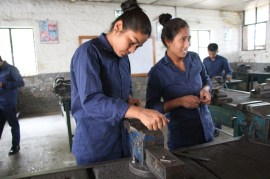
Nepal’s inattention to TVET undercuts its educational goals, and has particularly dramatic consequences for girls.  Girls’ participation in TVET could substantially increase their labor force participation, but it must be gender-transformative  to ensure equitable gender participation in all areas of training. My forthcoming policy brief   found significant barriers to girls’ participation in TVET programs and their acquisition of skills needed for lucrative, traditionally male-dominated occupations. These barriers include TVET underinvestment, limited information and opportunities, an unregulated labor market, and social and gender norms that view TVET as education for working-class men. When TVET is available for women, it often pushes them into fields of study that fit stereotypical social and reproductive roles, such as nursing and caregiving.

To realize education’s promise of a pathway to decent employment for all, there must be increased investment in a gender-transformative TVET that aligns girls’ skills with market demand, including combining them with entrepreneurship and life skills, and providing space to disrupt gender stereotypes. Application of the ACT framework—improving girls’ access to TVET programs, enabling their completion of TVET programs, and facilitating their transition to work—could allow Nepal to finally realize the promises of education. After all, the 2030 Agenda for Sustainable Development envisions the world with full gender equality, where women and girls are empowered (SDG 5), have equal access to quality education (SDG 4), and have equal participation in the labor market (SDG 8). To achieve these goals, Nepal’s government must partner with the private sector and civil society to invest in gender-transformative TVET.


from Brookings Topics – Global Education https://ift.tt/2M72FYa
via IFTTT

Webinar: Paying for education outcomes at scale in India

With only four out of ten children in low- and middle-income countries on track to gain secondary level skills by 2030, and only 88% of children in lower-middle income countries completing primary school, financing quality education is imperative. India, a country that contributes to a large portion of these sobering statistics, is home to a quarter of the 260 million children who are out-of-school globally. To attempt to address this problem, India is beginning to play a leading role in using innovative financing.

On November 6, the Center for Universal Education (CUE) at Brookings will host a webinar to discuss one such innovative financing structure, impact bonds—an outcomes-based financing tool where investors provide upfront capital to service providers. India has 3 contracted impact bonds, two of which are in the education sector: the Quality Education India (QEI) development impact bond (DIB) and the Educate Girls DIB. The QEI and Educate Girls DIBs provide interesting case studies to explore the potential and limitations of utilizing impact bonds to improve learning outcomes in India.

This event brings together key impact bond stakeholders from India, providing an opportunity to share lessons learned, and to work together to find solutions to pressing education challenges. In the webinar, CUE will also launch a comprehensive report on paying for education outcomes at scale in India. Key learnings from CUE’s research indicate that though impact bonds might not be the answer to all the challenges faced by the education system in India, judicious use of the tool has the potential to focus financing on results and reinforce the use of data and evidence in decisionmaking.


from Brookings Topics – Global Education https://ift.tt/33lmNva
via IFTTT