

… designing content for online learning, using simulations and gaming in the classroom and integrating computational thinking into school curriculum.
from Google Alert – “Computational thinking” https://ift.tt/2U5nveM
via critical thinking
Tag: IFTTT
Fabrication Lab Set Up At Odisha’s SOA University To Trigger Imagination Of Students
“This is an endeavour to foster curiosity, creativity and imagination in young minds and inculcate skills such as design mindset, computational thinking …
from Google Alert – “Computational thinking” https://ift.tt/37G1jf9
via critical thinking
List Of Free Google Digital Skills Courses For People Interested In Coding/Programming
Computational Thinking for Problem Solving – You'll learn about the pillars of computational thinking, how computer scientists develop and analyze …
from Google Alert – “Computational thinking” https://ift.tt/2vxw0Fd
via critical thinking
Major award for Derry teacher
“On hearing about a programme called Digital Schoolhouse that focuses on using play-based learning to teach computational thinking skills and …
from Google Alert – “Computational thinking” https://ift.tt/2U6iBOL
via critical thinking
ZP students ace Bebraschallenge
… national rank holders of the 2019 Bebras India Challenge, an international computational thinking competition, held between November 18 and 30.
from Google Alert – “Computational thinking” https://ift.tt/2Rws2oH
via critical thinking
How to design a university: A conversation with Doug Becker of Cintana Education
How to design a university: A conversation with Doug Becker of Cintana Education
By Rebecca Winthrop
About 220 million students are in higher education around the world today, but there are tremendous challenges in scaling those numbers. Nine out of 10 students globally do not have access to ranked universities, which tend to be the ones with the greatest resources in teaching and research. One solution is pairing unranked universities with ranked universities to lift up the quality of higher education for students across the globe.
In an ongoing exploration of trends in higher education, I recently sat down with Doug Becker, the founder and former CEO of Laureate Education, a company dedicated to expanding access to higher education around the world. Today, Doug has embarked on a new venture dedicated to advancing the science of university design and giving more students around the globe access to a high-quality education. Given the increased demand for higher education coupled with the rising costs and questions about the relevance of the skills required in a fast-changing world, there is considerable need to examine the design of higher education institutions globally.
Q: You have deep experience in higher education globally. What are some of the biggest challenges you see with higher education outside the United States?
A: In many of the countries that should be seeing the greatest amount of growth—for example, because of a growing middle class and workforce demand for higher education—the supply of qualified employees isn’t sufficient to meet the needs. Supply might be constrained by people’s ability to pay, by rapid change in workforce demand, or the absence of faculty with the prerequisite skills. So, it is really a question of what we should be doing to strengthen the universities which serve the vast majority of students but are not top-tier, ranked institutions with substantial resources necessary for scaling and innovation.
One of the biggest challenges to scaling access to quality learning is the design limitations of the current higher education system. The vast majority of institutions weren’t designed with today’s reality in mind—in other words, for an age of rapid technological change, global interconnectedness, and shifting labor market needs. So, the question is: What refreshes design? In the private sector, we know that what refreshes design is the market price and competition—the invisible hand of Adam Smith. This is difficult to recreate in the public sector, but it can be done through visionary leadership, and I am obsessed with helping institutions figure out the answer.
Q: Tell us more about how you’re envisioning tackling this university design and scale question.
A: One answer is to pair unranked universities with ranked universities—but that’s hard because many elite universities don’t want to work with an institution that they see as inferior to them in quality.
So, the idea behind Cintana, my new venture jointly developed with Arizona State University (ASU), is to create a network of ranked and unranked universities based on a significant two-way commitment. When a university chooses to join this network, we ask them to involve us in their strategic planning. Ultimately, it’s their design and their university, but we want a seat at the table during planning and design.
And once a design is in place, the network can help the institution tackle constraints. For example, most institutions aren’t working with the world’s best digital marketers, but our network will have the scale to attract that talent. As a network, we can anticipate things that the individual university might not. Through sharing intelligence and insights, we can bring new options to students around the world, including dual degrees from institutions in two different countries. If, for example, you’re a student in Egypt and you end up with both a local degree and an American degree of good quality, that could really help differentiate you in the job world.
While ASU is the core academic partner for Cintana, we will also find other ranked institutions that can contribute to this network and that seek to increase their own international impact. But participation in the network will also bring direct benefits to the ranked universities too. For example, most universities in the developed world want to engage more effectively with the world and increase their impact outside of their home country in the areas of teaching and research. That’s where a partner like Cintana can be extremely effective in helping expand their work.
Q: Are constraints such as changing workforce demand, cost models, and outdated university design consistent across the globe, or do they vary region to region?
A: I would say that these issues tend to always be there. The one area where there’s the biggest divergence from country to country is cost. Typically, to do higher education well, it is expensive no matter where you are. But containing costs is only one part of the equation; the other is the question of “who is going to pay?” In developed countries, the government has room to decide whether the person who is benefiting should pay for it, or whether society or employers should pay for it. In many emerging countries, especially the poorest ones, who pays is a much shorter conversation because the individual student just can’t pay—and certainly can’t pay at a level that would deliver the kind of quality that she wants and deserves.
Q: What do you think are some of the biggest opportunities for accelerating change?
A: One word: technology. I hesitate to say it because it is so obvious, but it does solve many challenges. Take faculty qualifications, for example: If nurse educators are available in the United States and math educators are available in India, technology can now match those supply sources with demand around the world. Of course, you have to be mindful that technology-based education may not deliver academic results unless you do it really well.
Beyond technology, I would say that design itself is an opportunity. What I learned at Laureate is that if we created a high-quality, highly visible university that grew quickly because of the strength of its offerings, it made the rest of the competitive market better. And that’s what is so exciting about this work on university design that I am engaged in now in partnership with ASU, a leader in innovation and design. I have seen how the power of a network can help drive improvements in quality and ultimately serve students better.
from Education Technology https://ift.tt/2RUWub3
via IFTTT
Computer science can help Africans develop skills of the future
(Many similar and related terms exist such as computing, informatics, computational thinking, and coding. We've used computer. science here, but the …
from Google Alert – “Computational thinking” https://ift.tt/2RRKyqJ
via critical thinking
Committee Gives Approval To First Learning Standards For Computer Science
… York State K-12 Computer Science and Digital Fluency Standards are organized into five concepts: impacts of computing, computational thinking, …
from Google Alert – “Computational thinking” https://ift.tt/3aLDJj8
via critical thinking
Computer science can help Africans develop skills of the future
By Rebecca Winthrop, Lauren Ziegler
The world is well into the Fourth Industrial Revolution, and yet education systems have not kept pace. Young people are often not learning the skills they need to succeed in the 21st century and interact with their changing world, such as digital literacy, problem solving, and critical thinking. Despite widespread recognition of the importance of these skills for the future in education policies, very few education systems have adapted to this reality. On the African continent, where 60 percent of the population is under age 25, the teaching of 21st century skills will be necessary for Africa to transform itself into a continent of growth and opportunity. If young people do not learn how to use and create with technology, they are sure to fall further behind.
How can Africa harness the power of technology when only 24 percent of Africans have access to the internet? Despite gains in internet access over the last several years, the region lags behind the rest of world in internet usage. A Pew survey of six African countries finds that internet usage is high among youth, which is good news for schools as it will help them teach 21st century skills; however, the study also finds that internet users tend to be male and have higher incomes and more education, meaning that more needs to be done to ensure all young people, no matter their gender or socioeconomic status, develop skills that enable their future success.
Education systems need to equip their students with basic tech proficiency and, going further, enable students to create with technology.
Education systems need to equip their students with basic tech proficiency and, going further, enable students to create with technology. The Center for Universal Education (CUE) at Brookings is interested in how education systems can foster the development of skills for the future through computer science (CS). (Many similar and related terms exist such as computing, informatics, computational thinking, and coding. We’ve used computer
science here, but the specific term is less important than whether students are learning and understanding how computers work.) CS education helps students understand how computers work, use algorithms to create computer programs and apps, and work with their peers to solve complex issues. Given that computers are all around us and technological advances are disrupting every industry, knowing how to use them will be beneficial to anyone, whether or not they wish to become a computer scientist.
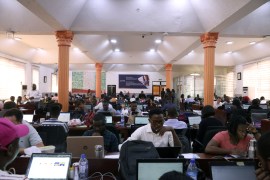
Already, there are many examples of CS education taking place in Africa. For example, the Ghana Code Club is a weekly after-school coding club that has trained more than 1,700 students and 300 teachers across 100 centers, and Teencoders, based in Nigeria, has reached over 5,000 students through after-school and weekend coding classes. While these nonformal education programs give learners critical exposure to the discipline, expanding CS education into formal primary and secondary schooling can ensure that many more young people learn computer science concepts.
One potentially promising way to overcome resource constraints is to teach without a computer.
Certainly, many constraints exist, including funding for equipment, lack of trained teachers, and lack of time during the school day to teach CS given other curricular priorities. One potentially promising way to overcome resource constraints is to teach without a computer. The platform CS Unplugged uses worksheets, magic tricks, art projects, and games to teach students computer science concepts offline. In one lesson, students learn about the binary system by creating a beaded necklace with their initials in binary numbers. While the teacher will need internet access to obtain the materials, these activities work well in cases where there are few computers in the classroom or intermittent internet access. A forthcoming CUE study looks further at the barriers to expanding CS education with the goal of uncovering models around the world that have succeeded despite various constraints.
As the examples of Ghana Code Club, Teencoders, and others show, many already recognize the need for young Africans to learn computer science. However, more needs to be done to ensure that all students have the opportunity to learn these concepts and to develop skills of the future.


from Brookings Topics – Global Education https://ift.tt/2TZjeJR
via IFTTT
Qatar- Dean’s Lecture Series enters 10th stimulating year
… Lawrence Gussman Professor of Computer Science, Columbia University (Computational thinking in programming language design); and Dr. Mary …
from Google Alert – “Computational thinking” https://ift.tt/2uxW02I
via critical thinking
 New innovative Approaches