

Gladwin also contributed funding to the Illinois Tech Active Computational Thinking Center, which will help facilitate partnerships between the school …
from Google Alert – “Computational thinking” https://ift.tt/2vJeA9f
via critical thinking
Tag: IFTTT
Exploring robotics part of St Joey’s schedule
Computational thinking and problem solving is a whole school focus at St Joseph's. Service. At St Joseph's we love giving back to our community.
from Google Alert – “Computational thinking” https://ift.tt/3cJ8NRB
via critical thinking
Clé de Peau Beauté Announces 2020 ‘Power of Radiance’ Awardees
… encouraging computational thinking, logical thinking, brain development and problem-solving. The organization was founded in September 2016 by …
from Google Alert – “Computational thinking” https://ift.tt/38xcNBi
via critical thinking
Girl Scouts Turns 108 Years Old
… camping, and the iconic cookie program—with exciting, modern programs in STEM, computer science, computational thinking, and engineering to …
from Google Alert – “Computational thinking” https://ift.tt/3aMJnAR
via critical thinking
Cambodia’s strategic scaling of 21st century skills and assessment to improve learning outcomes
Cambodia’s strategic scaling of 21st century skills and assessment to improve learning outcomes
By Esther Care, Ung Chinna, Sarin Sar, Hav Khou
Cambodia has been striving to improve its education system and has engaged in as many opportunities as possible to further student achievement. The country has participated in OECD’s PISA for Development, in the UNICEF-sponsored South East Asia Primary Learning Metric (SEA-PLM) program, and in the Optimizing Assessment for All (OAA) initiative at Brookings. Drawing lessons from the very different approaches in these assessment programs, Cambodia has assembled an impressive repertoire of skills and knowledge.
Outstandingly, the country has not backed off from its mission to change the status quo in its education system. The Minister of Education, Youth and Sport, H.E. Dr. Hang Chuon Naron, has said, “I don’t care what the results are; I just want to know what they are so that we know what to do about it.” As a testament to this principle, Cambodia is just one of three PISA for Development countries that will continue engagement with OECD’s international large-scale assessment through PISA-2021, to provide comparative data across 2018-2021 that will reflect the impact of education initiatives currently being implemented.
Cambodia’s Education Quality Assurance Department (EQAD) of the Ministry of Education, Youth and Sport recently showcased its commitment to improvement in a two-day workshop. Concerned about the quality and usefulness of classroom-based assessment, the EQAD unit has developed a strategy.
The workshop
Held in the Kampot Provincial Teacher Training Center in February, EQAD assembled a diverse group of educators, with the conviction that educators from all levels of the system need to be brought into discussions on how to change practices. Following a series of sessions designed to familiarize provincial education officials and teachers with outcomes from OAA’s pilot assessments of 21st century skills, the EQAD staff worked with participants to develop assessment items for classroom use.
As the first short-term target, teachers designed items for use in monthly tests of student progress. An additional target for the monthly tests was to ensure at least one item per subject would reflect OAA’s approach of assessing 21st century skills embedded in subject curricula. Over time, this latter approach will be scaled up to support regular classroom teaching and learning.
An overarching goal of the workshop was to support teachers to move beyond the textbooks that they currently rely on to consider the curriculum more broadly. As Cambodia shifts away from reliance on rote learning, the teachers themselves need greater familiarity with the curriculum and curricular goals. The OAA assessment task structures provide exactly this facility: Not only do they require students to think beyond routine application of their learning, they model this approach to teachers.
Scaling 21st century skills
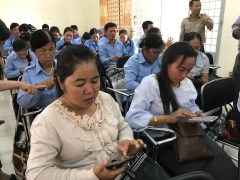
The app, Telegram, has allowed EQAD to provide just-in-time materials in their capacity-building activities. Educators can access Telegram easily on their mobile phones, download materials, chat, and send all sorts of documents and images, and thereby engage in a dynamic community characterized by quick interaction. As can be seen in the below images from the workshop, the phones provided an essential resource—unlike in many gatherings where individuals looking at their phones indicates disengagement. It was great to see the start of basic information and communications technology literacy in a Cambodian education context.
The Provincial Office of Education (PoE) staff and school directors, together with the Teacher Training Department and Primary Education Department, developed action plans to enable continuing technical item development for the school-based groups after the workshop. The plan is for the four pilot schools that participated in the OAA initiative to scale up to additional grade levels, with EQAD support, as their confidence and expertise builds. To support these activities, the schools will meet in their technical groups, one in Phnom Penh and one in Kandal Province, each month. The Telegram exchange of documents and sharing of resources will facilitate EQAD’s review of item drafts for use in the classroom as teacher expertise develops.
EQAD’s plans to share OAA procedures and practices with teacher training centers in other provinces and institutes so that both trainers and trainees can continue to build knowledge around concepts of 21st century skills assessment and incorporate it into teaching and learning. In the immediate future, EQAD will also scale up to two schools, Chaktomok Primary School in Phnom Penh and Takhmao Primary School in Kandal province. These schools will join the original four to work together to share knowledge and practices.
In many countries, we see responsibility for educational assessment separated across departments or centers, such that responsibility for large-scale testing is taken by one department, and responsibility for classroom-based assessment is taken by another. EQAD has acknowledged the importance of alignment between these different levels of assessment, and while responsible for Cambodia’s large-scale assessment, also values classroom assessment as the foundation for change in education practices. With EQAD’s work to create alignment throughout the system, as demonstrated by the workshop, the future of Cambodia’s education system looks bright.
from Education Technology https://ift.tt/2TEKdKh
via IFTTT
Cambodia’s strategic scaling of 21st century skills and assessment to improve learning outcomes
By Esther Care, Ung Chinna, Sarin Sar, Hav Khou
Cambodia has been striving to improve its education system and has engaged in as many opportunities as possible to further student achievement. The country has participated in OECD’s PISA for Development, in the UNICEF-sponsored South East Asia Primary Learning Metric (SEA-PLM) program, and in the Optimizing Assessment for All (OAA) initiative at Brookings. Drawing lessons from the very different approaches in these assessment programs, Cambodia has assembled an impressive repertoire of skills and knowledge.
Outstandingly, the country has not backed off from its mission to change the status quo in its education system. The Minister of Education, Youth and Sport, H.E. Dr. Hang Chuon Naron, has said, “I don’t care what the results are; I just want to know what they are so that we know what to do about it.” As a testament to this principle, Cambodia is just one of three PISA for Development countries that will continue engagement with OECD’s international large-scale assessment through PISA-2021, to provide comparative data across 2018-2021 that will reflect the impact of education initiatives currently being implemented.
Cambodia’s Education Quality Assurance Department (EQAD) of the Ministry of Education, Youth and Sport recently showcased its commitment to improvement in a two-day workshop. Concerned about the quality and usefulness of classroom-based assessment, the EQAD unit has developed a strategy.
The workshop
Held in the Kampot Provincial Teacher Training Center in February, EQAD assembled a diverse group of educators, with the conviction that educators from all levels of the system need to be brought into discussions on how to change practices. Following a series of sessions designed to familiarize provincial education officials and teachers with outcomes from OAA’s pilot assessments of 21st century skills, the EQAD staff worked with participants to develop assessment items for classroom use.
As the first short-term target, teachers designed items for use in monthly tests of student progress. An additional target for the monthly tests was to ensure at least one item per subject would reflect OAA’s approach of assessing 21st century skills embedded in subject curricula. Over time, this latter approach will be scaled up to support regular classroom teaching and learning.
An overarching goal of the workshop was to support teachers to move beyond the textbooks that they currently rely on to consider the curriculum more broadly. As Cambodia shifts away from reliance on rote learning, the teachers themselves need greater familiarity with the curriculum and curricular goals. The OAA assessment task structures provide exactly this facility: Not only do they require students to think beyond routine application of their learning, they model this approach to teachers.
Scaling 21st century skills
The app, Telegram, has allowed EQAD to provide just-in-time materials in their capacity-building activities. Educators can access Telegram easily on their mobile phones, download materials, chat, and send all sorts of documents and images, and thereby engage in a dynamic community characterized by quick interaction. As can be seen in the below images from the workshop, the phones provided an essential resource—unlike in many gatherings where individuals looking at their phones indicates disengagement. It was great to see the start of basic information and communications technology literacy in a Cambodian education context.
The Provincial Office of Education (PoE) staff and school directors, together with the Teacher Training Department and Primary Education Department, developed action plans to enable continuing technical item development for the school-based groups after the workshop. The plan is for the four pilot schools that participated in the OAA initiative to scale up to additional grade levels, with EQAD support, as their confidence and expertise builds. To support these activities, the schools will meet in their technical groups, one in Phnom Penh and one in Kandal Province, each month. The Telegram exchange of documents and sharing of resources will facilitate EQAD’s review of item drafts for use in the classroom as teacher expertise develops.
EQAD’s plans to share OAA procedures and practices with teacher training centers in other provinces and institutes so that both trainers and trainees can continue to build knowledge around concepts of 21st century skills assessment and incorporate it into teaching and learning. In the immediate future, EQAD will also scale up to two schools, Chaktomok Primary School in Phnom Penh and Takhmao Primary School in Kandal province. These schools will join the original four to work together to share knowledge and practices.
In many countries, we see responsibility for educational assessment separated across departments or centers, such that responsibility for large-scale testing is taken by one department, and responsibility for classroom-based assessment is taken by another. EQAD has acknowledged the importance of alignment between these different levels of assessment, and while responsible for Cambodia’s large-scale assessment, also values classroom assessment as the foundation for change in education practices. With EQAD’s work to create alignment throughout the system, as demonstrated by the workshop, the future of Cambodia’s education system looks bright.


from Brookings Topics – Global Education https://ift.tt/3aH7m4o
via IFTTT
STEM is part of everything at Osage schools
Brian Aspinall, an educator, three-time TEDx speaker, coder and global consultant, will talk about the importance of computational thinking and why …
from Google Alert – “Computational thinking” https://ift.tt/2vNFuMU
via critical thinking
You must be coding!
… that coding is one way to help children identify a problem, break it down into small steps and make it solvable – the basics of computational thinking.
from Google Alert – “Computational thinking” https://ift.tt/3cRC4ts
via critical thinking
Cracking the code: Students unite in computer engineering
“There are really interesting activities regarding computational thinking that are on paper and so we're trying to sort of push the curriculum down …
from Google Alert – “Computational thinking” https://ift.tt/38q6640
via critical thinking
Future Ready: 4 Skills Your Team Will Need In 2030
Computational thinking may involve a little math, but in short, it means problem-solving — the ability to think critically, recognize patterns, devise …
from Google Alert – “Computational thinking” https://ift.tt/2TOnDh7
via critical thinking
 New innovative Approaches