

The platform enables student to acquire computational thinking, problem solving skills and learn coding as a life skill all via a flexible and scalable …
from Google Alert – “Computational thinking” https://ift.tt/2qcJG5H
via critical thinking
Tag: IFTTT
Computer Science and Teaching Future Generations
Cybersecurity, robotics, data analysis, and computational thinking are all topics that fall under the science. Being able to navigate on a computer …
from Google Alert – “Computational thinking” https://ift.tt/2ORzx8Q
via critical thinking
Tangible programming
… programming language for teaching children ages seven to eleven basic programming concepts and computational thinking regardless of their level …
from Google Alert – “Computational thinking” https://ift.tt/2ptBAoT
via critical thinking
Charts of the Week: Gender and education

By Fred Dews, Tamari Dzotsenidze
Brooking scholars have done extensive research on policy issues focused on women and girls, especially in education. In observance of United Nations’ International Day of the Girl Child, here are some charts highlighting some issues where gender and education intersect. Visit the Center for Universal Education for the latest research on girls’ education.
GIRLS ARE DISADVANTAGED IN SECONDARY SCHOOL GLOBALLY
Rebecca Winthrop, director of the Center for Universal Education, and Eileen McGivney studied disadvantages faced by girls attending secondary school. Analyzing 2012 data, they found that while in 51 countries girls outpaced boys in secondary school enrollment, in 56 countries girls lagged boys, while in an additional 23 countries girls were severely disadvantaged in enrollment. This means that despite both boys and girls experiencing enrollment disadvantage in about the same number of countries, the number of countries in which girls are severely disadvantaged is nearly quadruple those in which boys are severely disadvantaged. Winthrop and McGivney identified these “girls’ education hotspots” across Asia and sub-Saharan Africa where, they note, many girls are married before 18, struggle with enrollment, “and in at least 15 countries [face] attacks on their lives for participating in education.”

MORE FEMALE STEM TEACHERS MAY INCREASE GENDER EQUALITY IN STEM
Michael Hansen, director of the Brown Center on Education Policy, and Diana Quintero examined whether increasing numbers of female teachers disadvantage boys in the education system. They found that while research shows that the presence of female professors results in higher grades and enrollment for female science, technology, engineering, and math (STEM) students, there is no research that suggests that this has a negative effect on male participation or outcomes. “In other words,” Hansen and Quintero wrote, “having more women leading math and science K-12 classrooms could actually be a preferred strategy to promote more gender equity in workforce outcomes.”

IDENTIFYING THREE TYPES OF GENDER EDUCATION INEQUALITY
Elizabeth King, a nonresident senior fellow with the Center for Universal Education, examined three types of global gender education inequalities, and outlined four obstacles to improving girls’ education worldwide. She argued that both direct and indirect costs of attending school are higher for girls, and that social norms and expectations including marriage keep girls out of school. In order to address these inequalities, there must be gender-based systemic reform.


from Brookings Topics – Global Education https://ift.tt/35EC8c8
via IFTTT
Alternate tech education venture SOAL raises $300000 from Astarc Ventures
… a 14 week program helping learners solve over 145 programming challenges that utilise various domains of computational thinking and JavaScript.
from Google Alert – “Computational thinking” https://ift.tt/32nZqBm
via critical thinking
$672K grant to support STEM education in schools
Our project brings computational thinking straight to the mathematics classroom, making access to computational thinking a reality for all students.”.
from Google Alert – “Computational thinking” https://ift.tt/2VGgmjS
via critical thinking
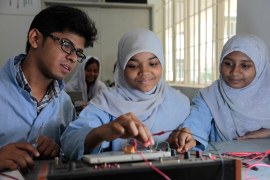
Barriers to STEM education for rural girls
By Nasrin Siddiqa
As one of the world’s fastest-growing economies, Bangladesh aims to become a middle-income country by 2021 and a high-income country by 2041. To attain these goals, the country must face global challenges head on by strengthening existing industries and preparing itself for industries that have yet to emerge. To do this, it
must tap the full potential of its human capital. Although Bangladesh made strides in access to education during the Millennium Development Goals era, poor girls continue to fall behind despite their ambitions to lead the country to change—a gap that affects their work outcomes once they leave school. The skills that Bangladesh’s youth need to thrive in a world of rapid technological advancement will require a response by policymakers and practitioners alike.
In this video, Nasrin Siddiqa, 2019 Echidna Global Scholar, discusses how STEM education can help girls—and in particular, rural girls—develop every day transferrable skills to help them succeed in a changing, competitive job environment.
This policy paper unveils the barriers to educational opportunities for rural girls in Bangladesh, focusing specifically on science, technology, engineering, and mathematics (STEM) education. It reflects upon a survey of 500 rural secondary-level schoolgirls, 100 parents, and 75 teachers from 30 rural schools of the district of Gazipur. The study identified barriers to STEM education at three levels—individual, institutional, and societal—that revealed both systemic and socio-cultural issues that actors in policy and practice can tackle. It provides clear recommendations for action and examples of practices that have started to fill the gap globally. If Bangladesh is to accomplish its goals and tap the potential of all its youth for rapid development, breaking the barriers to STEM education for all children is a key place to start.

from Brookings Topics – Global Education https://ift.tt/2VJRGqP
via IFTTT
India’s policy on early childhood education
By Samyukta Subramanian
The Delhi government in India recently launched its preschool curriculum for the city’s 10,897 community-based preschool centers. The draft National Education Policy of India, made public in June 2019, dedicates its first chapter to the importance of early childhood care and education and the need to extend the right to education to every child who is three to six years old.
In this video, Samyukta Subramanian, 2019 Echidna Global Scholar, discusses how we must tackle gender inequality in India in the early years through engaging girls, boys, teachers, and parents.
It is in this context that this paper urges the government to ensure that gender sensitivity is embedded in every initiative of early childhood education (ECE) in India from here onward. Based on interviews with mothers of preschool children in underresourced communities and with teachers as well as observations of government-supported preschool centers, this paper builds the current narrative of the preschool child’s ecosystem; notes the lack of gender-sensitive pedagogy in this space; and makes recommendations for what a gender-transformative approach in ECE in India should entail for men and boys, girls and women, so that India can strive for a more gender-equitable society in the years to come.

from Brookings Topics – Global Education https://ift.tt/2OS7shJ
via IFTTT
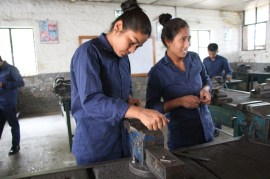
Girls’ transitions to work through higher-quality TVET programs in Nepal
By Anil Paudel
Education is not just about earning degrees; it is much more than that. For decades, global and national development discussions have emphasized education as a powerful tool for poverty reduction, economic growth, and human well-being. Global policies like the United Nations’ Millennium Development Goals (MDGs) and Sustainable Development Goals (SDGs) as well as national education sector plans reflect this widespread belief. However, poverty reduction and economic growth are also about earnings and making a living. As such, the school-to-work or education-to-employment transition becomes critical for realizing education’s potential inreducing poverty and thus should be closely tracked.
In this video, Anil Paudel, 2019 Echidna Global Scholar, discusses the importance of investing in a gender-transformative TVET education to help improve girls’ real-world employability.
In Nepal, although education is a priority for all stakeholders—from students and parents to policymakers and employers—they have varying expectations on the promise of education. Students and parents expect education to provide better life outcomes, particularly successful employment and a decent living. Meanwhile, employers expect education to produce a workforce-ready population. But neither group is getting the outcomes they expect. Sadly, the education system has placed little emphasis on technical and vocational education and training (TVET), widely considered by international development agencies as an important tool in strengthening the school-to-work transition, especially when basic education does not adequately prepare
youth for the world of work.
Access to TVET is very limited and additional barriers make it harder for girls to participate in TVET programs. Despite the country’s remarkable progress in enrolling girls in school, dropping out remains a problem. And, although boys and girls in Nepal are almost equally likely to drop out from school, boys benefit more from the choices offered by TVET and from the economic opportunities both domestically and overseas.
This paper seeks to increase understanding of how to improve girls’ and young women’s participation in TVET and to help strengthen the bridge between their education and employment.
from Brookings Topics – Global Education https://ift.tt/2VIINNU
via IFTTT
LSU team receives $5 million in grants to bring computer science courses to Louisiana schools
The team designed a curriculum to teach the fundamentals of programming and computational thinking due to the subjects' increasing importance in …
from Google Alert – “Computational thinking” https://ift.tt/32eaFw4
via critical thinking
 New innovative Approaches